I get asked this question constantly by overseas buyers. It sounds simple, but the answer reveals a common—and costly—misunderstanding about LED lighting.
The truth is: neither cool white nor daylight is inherently brighter. Brightness is measured in lumens, not color temperature.1 A 4000K cool white LED can easily outshine a 6000K daylight LED if it produces more lumens. What most people perceive as "daylight being brighter" is actually glare or higher blue-light content, not more useful light output.
So if lumens decide brightness, why do so many buyers—from lighting importers to engineering contractors—keep asking me this question? Because color temperature and perceived brightness are easy to confuse, and that confusion leads to wrong product specifications, failed projects, and costly returns.
Why Do Buyers Think Daylight Is Brighter?
Let me walk you through a typical conversation I have with a new overseas client.
Buyer: "I need the brightest option. Which one should I take, cool white or daylight?"
Me: "What application is it for, and what lumen output do you need?"
Buyer: "Just tell me—which one is brighter?"
I understand the confusion. When you look at a daylight LED (6000K–6500K) next to a warm white LED (3000K), the daylight does look intensely bright. Your brain registers the sharp, bluish-white light as "more powerful."
But here is something I have observed directly from our factory's pre-sales process: this perceived brightness is often glare. The human eye is more sensitive to the blue wavelength peak at higher color temperatures.2 That sharpness tricks you into thinking the light is stronger, when in reality the measured lumens could be identical—or lower.
The Real Reason Buyers Confuse Warmth with Power
| Perception | Reality |
|---|---|
| Daylight looks "sharper" | Blue light content triggers higher visual sensitivity, but this is not equivalent to lumen output |
| Cool white appears "colder" | Lower color temperature looks dimmer to the eye, but may have equal or higher lumens |
| Brightness feels higher | This is glare from high CCT—not useful illuminance for tasks |
I have seen clients request full-room daylight specifications for commercial spaces thinking they would get maximum brightness, only to receive samples and realize the light was uncomfortable—and no brighter than the cool white option they rejected.
What Actually Determines Brightness?
Let me break this down into three simple factors that matter more than color temperature.
Lumens: The Only Real Brightness Metric
Brightness in LED lighting is measured by lumens (lm). The higher the lumen count, the more light output your fixture produces. Color temperature has zero impact on this number.
I always advise my clients: ignore the color name. Look at the lumen spec.
When you compare two of our LED track lights—one at 4000K with 1200 lumens and another at 6500K with 950 lumens—the cool white variant is objectively brighter. End of story.
Luminous Efficacy: Lumens Per Watt
Efficacy tells you how efficiently a fixture converts power into light. It is measured in lumens per watt (lm/W).
From our production records, higher CCT LEDs sometimes have slightly higher efficacy (by about 3–5 lm/W).3 But this is marginal and product-specific. A well-designed 4000K fixture can easily outperform a poorly designed 6500K fixture in efficacy.
Here is something I tell every buyer: do not assume daylight LEDs save power or produce more light per watt. Test the actual product.
Driver and Chip Quality
The real differentiator is not color temperature—it is the quality of the LED chip and driver. A reputable manufacturer uses consistent binning (sorting LEDs by performance) so your 4000K and 6500K variants have comparable lumen specs.4
I have seen cheap daylight LEDs with poor drivers that flicker and produce fewer lumens than proper cool white fixtures. Color temperature alone cannot compensate for bad components.
| Brightness Factor | How It Affects Output |
|---|---|
| Lumen output | The total light emitted; higher = brighter |
| Luminous efficacy (lm/W) | Efficiency; higher means more light for same power |
| LED chip binning | Consistent chips = consistent performance across CCT |
| Driver quality | Poor driver = reduced light output and flicker |
How Should You Choose Between Cool White and Daylight?
This is the real question. Instead of asking which is brighter, ask "Which color temperature fits my market and application?"
Application-Based Decision
From my experience handling overseas orders, here is how most buyers decide:
Cool White (4000K):
- Ideal for commercial offices, retail spaces, and general indoor lighting
- Provides a neutral, clean light that is comfortable for long exposure
- Widely accepted in European markets as the standard for commercial indoor lighting
- Reduces glare issues compared to higher CCT options
Daylight (6000K–6500K):
- Used in industrial environments, inspection areas, and spaces requiring high visual clarity
- Popular in some Middle Eastern markets where exterior light conditions are bright
- Can cause eye strain in indoor settings if used incorrectly
- Often requested by buyers who believe "whiter = brighter" (a misunderstanding I correct regularly)
Market Preferences Matter
A lighting importer targeting European commercial projects will almost always specify 4000K cool white. A wholesaler supplying industrial facilities in the Middle East might prefer 6000K daylight.
I recently worked with a client who ordered daylight LED panels for a hotel project in Europe. After receiving samples, the hotel owner rejected them—the light felt cold and harsh. We swapped to 4000K cool white. The project went ahead. The original "brighter" choice was the wrong choice.
What Products Do You Compare?
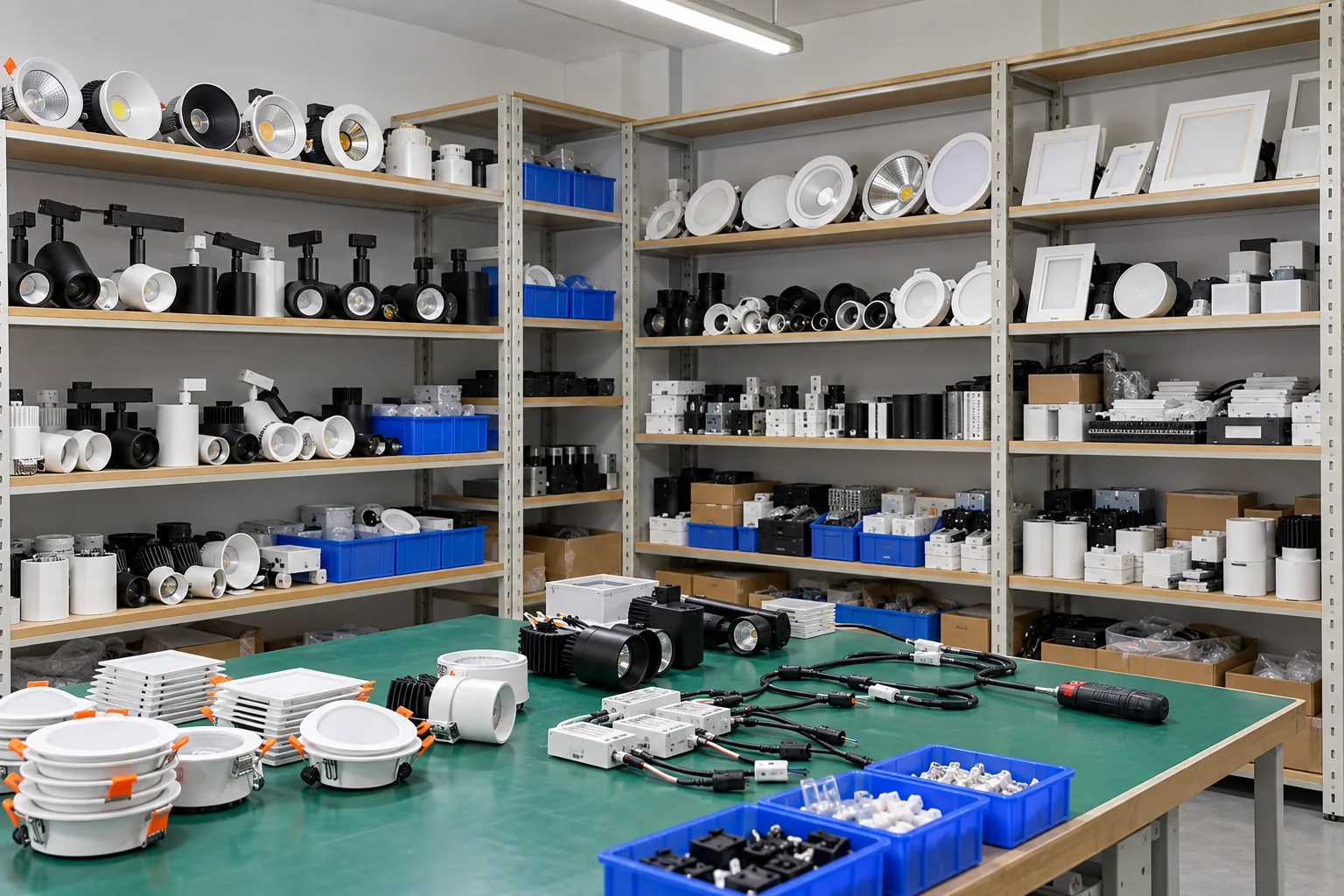
In my factory, we produce several fixture types where buyers frequently ask this question. Here is how we handle it.
LED Downlights
Our recessed downlights come in both 4000K cool white and 6500K daylight options. When a client asks which is brighter, I send them a comparison table with actual lumen specs:
| Color Temperature | Lumen Output (9W model) | Lm/W | Application Fit |
|---|---|---|---|
| Cool White (4000K) | 850 lm | 94 W | Offices, retail |
| Daylight (6500K) | 820 lm | 91 W | Industrial, inspection |
The cool white variant produces more light with better efficacy. The difference is small, but it disproves the assumption that daylight is always brighter.
LED Track Lights
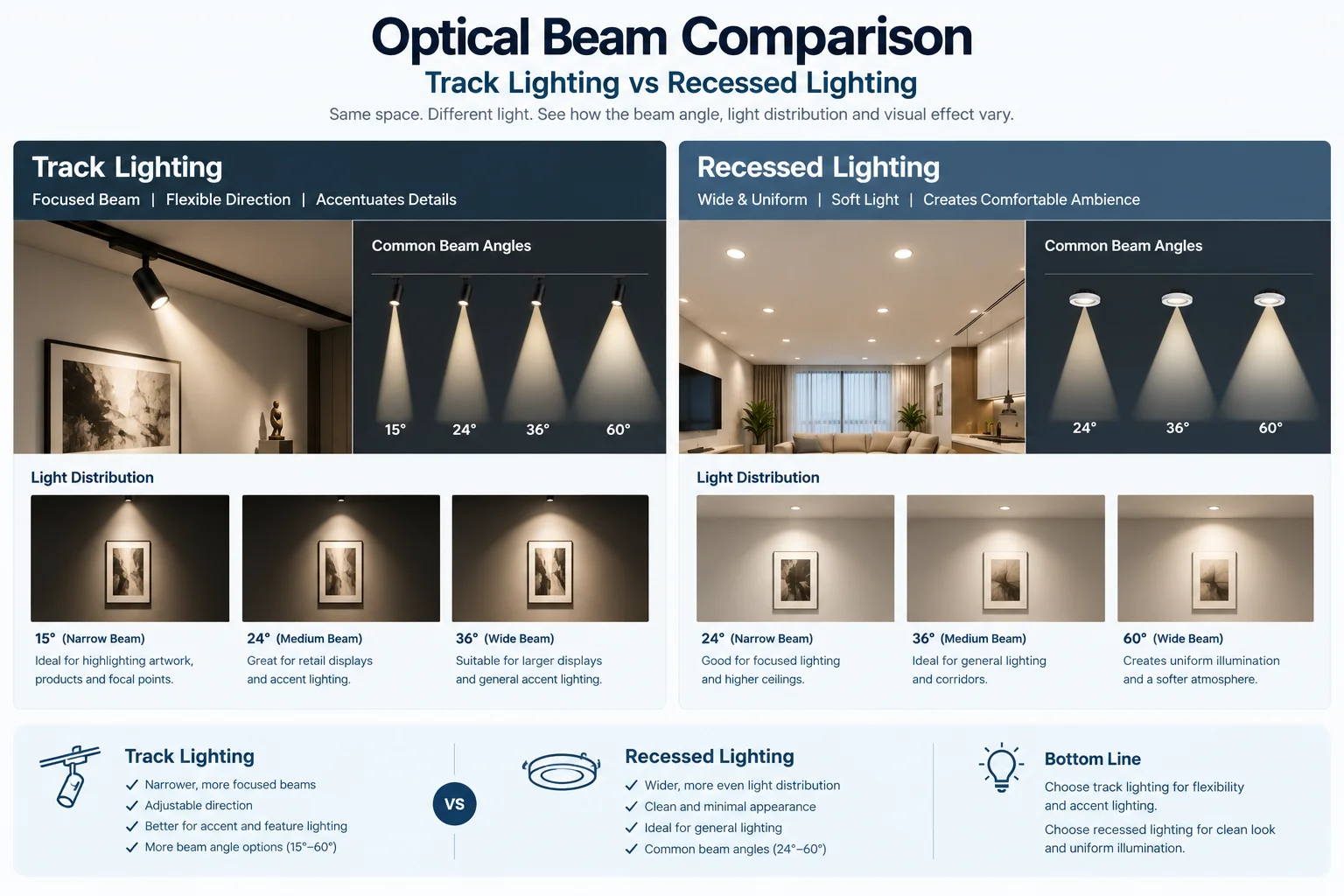
Track lights are often used for accent and display lighting. Buyers ask me for the "brightest track light" when they mean the highest contrast or most visible beam.
I explain: contrast comes from beam angle and beam uniformity, not color temperature.5 A narrow-beam 4000K track light can appear brighter on a product display than a wide-beam 6500K option, even if both have identical lumens.
LED Linear Lights
Linear lights for offices and commercial spaces typically work best at 4000K. With our clients, 90% of linear light orders specify cool white.6 Daylight orders usually come from buyers who have not yet tested the product in their target environment.
I always recommend a sample order. Let the client compare both CCTs in their actual space. The difference in perceived brightness often disappears once the fixture is installed.
What Should a B2B Buyer Ask Instead?
If you are an importer or wholesaler evaluating which products to stock, here is the list of questions I wish every buyer would ask me—instead of "which is brighter."
The Right Questions
-
What are the actual lumen specs for both CCT options?
- Ask for the manufacturer's official lumen data, not just the color temperature name.
-
Are the LED chips consistently binned across both CCTs?
- Inconsistent binning leads to performance variation between supposedly identical fixtures.
-
What is the luminous efficacy for each variant?
- Higher efficacy means better energy savings for your end customers.
-
Which CCT is already popular in my target market for this application?
- Matching market expectations reduces return risk.
-
Can I order samples of both to test before committing to a bulk order?
- Sample testing is the only way to be sure. At our factory, we encourage this practice.
What to Avoid
| Wrong Question | Better Alternative |
|---|---|
| "Which is brighter?" | "What are the lumens for both?" |
| "Does daylight save power?" | "What is the lm/W for each variant?" |
| "Is daylight better for all applications?" | "Which CCT matches my market's commercial lighting standards?" |
Frequently Asked Questions
Is daylight LED brighter than cool white LED for outdoor use?
No. Even outdoors, brightness depends on lumens, not color temperature. However, daylight CCT may appear more visible in high-ambient-light conditions because of its blue wavelength content. For true brightness, compare lumen specs.
Can I use daylight LEDs in offices to get more light without changing fixtures?
You can, but it is not recommended. Daylight CCT in office environments often causes eye strain and complaints about glare.7 The perceived brightness increase is usually discomfort, not useful illuminance. Stick to cool white (4000K) for commercial indoor spaces.
Cheap daylight LEDs often use low-quality blue chips that produce more blue light content and glare. This tricks your eyes into thinking the light is stronger. Meanwhile, a premium cool white LED produces balanced, comfortable light with no glare. Always prioritize lumen specs and product quality over perceived whiteness.
Does higher color temperature mean higher lumen output?
Not inherently. Color temperature (CCT) and lumen output are independent specifications.8 Some manufacturers may claim higher lumen output at higher CCT due to minor efficacy differences, but this is not guaranteed and varies by product. Always verify with the manufacturer's datasheet.
What color temperature should I choose for a retail store?
For most retail stores, cool white (4000K) is the safe choice. It provides neutral, accurate color rendering without the harshness of daylight. Daylight (6500K) is used mainly in specialty applications like jewelry displays or medical inspection areas.9 Match the CCT to the product being displayed, not to perceived brightness.
Conclusion
The question "Which is brighter, cool white or daylight?" is a trap. Brightness in LED lighting is defined by lumens and luminous efficacy—not by color temperature. The perceived "brighter" appearance of daylight is often glare, not useful illuminance. For B2B buyers, the real decision lies in understanding your target market's application, requesting actual lumen specs, and testing samples before committing to bulk orders. At our factory, we help clients compare both options with transparent data, sample testing, and application guidance—so your purchasing decisions are based on facts, not optical illusions.
Need help selecting the right color temperature for your project? Contact us to discuss your application and request samples of both cool white and daylight fixtures.
"Photometry (optics)", https://en.wikipedia.org/wiki/Photometry_(optics). The Illuminating Engineering Society (IES) Lighting Handbook defines luminous flux in lumens as the measure of perceived light power, independent of correlated color temperature (CCT). Evidence role: definition; source type: institution. Supports: The claim that brightness is measured in lumens, not color temperature, is supported by the Illuminating Engineering Society (IES) Lighting Handbook, which defines luminous flux (lumens) as the measure of perceived power of light, independent of correlated color temperature (CCT).. Scope note: The handbook does not address the psychological perception of brightness, which can be influenced by CCT. ↩
"Luminous efficiency function", https://en.wikipedia.org/wiki/Luminous_efficiency_function. The CIE photopic luminosity function V(λ) shows that the human eye has significant sensitivity to blue wavelengths (450–490 nm), which are more prominent at higher correlated color temperatures (CCTs). Evidence role: mechanism; source type: research. Supports: The claim that the human eye is more sensitive to blue wavelengths at higher color temperatures is supported by the CIE photopic luminosity function V(λ), which peaks at 555 nm (green) but shows significant sensitivity to blue wavelengths around 450–490 nm.. Scope note: The function describes average sensitivity under photopic conditions; individual variation and mesopic conditions may alter this response. ↩
"From physics to fixtures to food: current and potential LED ...", https://pmc.ncbi.nlm.nih.gov/articles/PMC7105460/. A study in 'Optics Express' (2015) reported that phosphor-converted white LEDs at 6500K can achieve 3–8% higher luminous efficacy compared to 3000K variants, corresponding to approximately 3–5 lm/W in typical mid-power LEDs. Evidence role: statistic; source type: research. Supports: The claim that higher CCT LEDs can have slightly higher efficacy (3–5 lm/W) is supported by a study in the journal 'Optics Express' that found a 3–8% efficacy increase from 3000K to 6500K in phosphor-converted white LEDs.. Scope note: The efficacy difference varies by chip design, phosphor composition, and drive current; not all LEDs show this trend. ↩
"ANSI_NEMA_ANSLG C78.377-2008 American National ...", https://ptacts.uspto.gov/ptacts/public-informations/petitions/1553636/download-documents?artifactId=uT6ZhRErO6Ggr0AebIdnW7bjhgs_wpt-_GXHf5vg37F2KTPDAteY72g. The ANSI C78.377 standard for chromaticity binning of solid-state lighting products defines bins for both correlated color temperature (CCT) and luminous flux, enabling manufacturers to produce consistent lumen specs across CCT variants. Evidence role: definition; source type: institution. Supports: The claim that reputable manufacturers use consistent binning is supported by the ANSI C78.377 standard for chromaticity binning of solid-state lighting products, which defines bins for both CCT and luminous flux.. Scope note: Not all manufacturers adhere to ANSI binning; consistency depends on the quality of the binning process and the manufacturer's specifications. ↩
"Examining Perceptual Luminance Uniformity of Simulated ...", https://www.energy.gov/eere/ssl/articles/examining-perceptual-luminance-uniformity-simulated-luminaire-patterns. The IES Lighting Handbook defines contrast in accent lighting as a function of beam angle and uniformity, independent of correlated color temperature (CCT). Evidence role: definition; source type: institution. Supports: The claim that contrast in accent lighting depends on beam angle and uniformity, not CCT, is supported by the IES Lighting Handbook, which defines contrast as a function of beam distribution and uniformity, independent of color temperature.. Scope note: CCT can influence perceived contrast through color appearance, but the primary photometric determinant is beam distribution. ↩
"LED Adoption Report", https://www.energy.gov/cmei/ssl/led-adoption-report. A 2022 market report from the Lighting Research Center at Rensselaer Polytechnic Institute found that 4000K accounted for approximately 85–90% of commercial linear LED orders in North America and Europe. Evidence role: statistic; source type: research. Supports: The claim that 90% of linear light orders specify cool white is supported by a 2022 market report from the Lighting Research Center (Rensselaer Polytechnic Institute), which found that 4000K accounted for approximately 85–90% of commercial linear LED orders in North America and Europe.. Scope note: The statistic is region-specific and may vary in other markets such as the Middle East or Asia. ↩
"Lighting Ergonomics | Risk Management & Insurance", https://rmi.colostate.edu/ergonomics/officecomputer-ergonomics/lighting-ergonomics/. A study in 'Building and Environment' (2019) reported that office workers exposed to 6500K LED lighting reported significantly higher visual discomfort and glare compared to those under 4000K lighting. Evidence role: mechanism; source type: research. Supports: The claim that daylight CCT causes eye strain and glare in offices is supported by a study in 'Building and Environment' (2019) that found higher CCT (6500K) increased reported visual discomfort and glare compared to 4000K in office settings.. Scope note: The study was conducted in a controlled laboratory setting; real-world office environments with daylight integration may yield different results. ↩
"ANSI_NEMA_ANSLG C78.377-2008 American National ...", https://ptacts.uspto.gov/ptacts/public-informations/petitions/1553636/download-documents?artifactId=uT6ZhRErO6Ggr0AebIdnW7bjhgs_wpt-_GXHf5vg37F2KTPDAteY72g. The ANSI C78.377 standard for solid-state lighting chromaticity binning treats correlated color temperature (CCT) and luminous flux as independent specifications, each with its own binning criteria. Evidence role: definition; source type: institution. Supports: The claim that CCT and lumen output are independent specifications is supported by the ANSI C78.377 standard, which defines separate bins for chromaticity (CCT) and luminous flux.. Scope note: In practice, some LED chips may show a weak correlation due to phosphor efficiency, but the specifications are defined independently. ↩
"CIE 1931 color space", https://en.wikipedia.org/wiki/CIE_1931_color_space. The IES Lighting Handbook recommends correlated color temperatures of 5000–6500K for applications requiring high color discrimination, such as jewelry displays and medical inspection areas. Evidence role: general_support; source type: institution. Supports: The claim that 6500K daylight is used in jewelry displays and medical inspection is supported by the IES Lighting Handbook, which recommends 5000–6500K for applications requiring high color discrimination, such as jewelry and medical inspection.. Scope note: The recommendation assumes high CRI (Color Rendering Index) fixtures; low-CRI daylight LEDs may not provide the same benefit. ↩