
Sourcing commercial LED lighting for overseas projects often leads to costly site installation errors, mismatched color rendering, or early driver failure. When procurement teams rely solely on reference photos or headline wattage, project delays escalate quickly. You can eliminate these costly procurement risks by mastering technical evaluation, clear specification briefs, and strict factory verification protocols.
To successfully buy commercial LED lighting, procurement teams must look past basic fixture aesthetics and establish a precise technical brief. This process involves defining structural dimensions and mounting methods, selecting appropriate thermal materials and power supplies, matching optical distributions to the visual task, and validating production quality through physical sample testing and factory burn-in inspections.
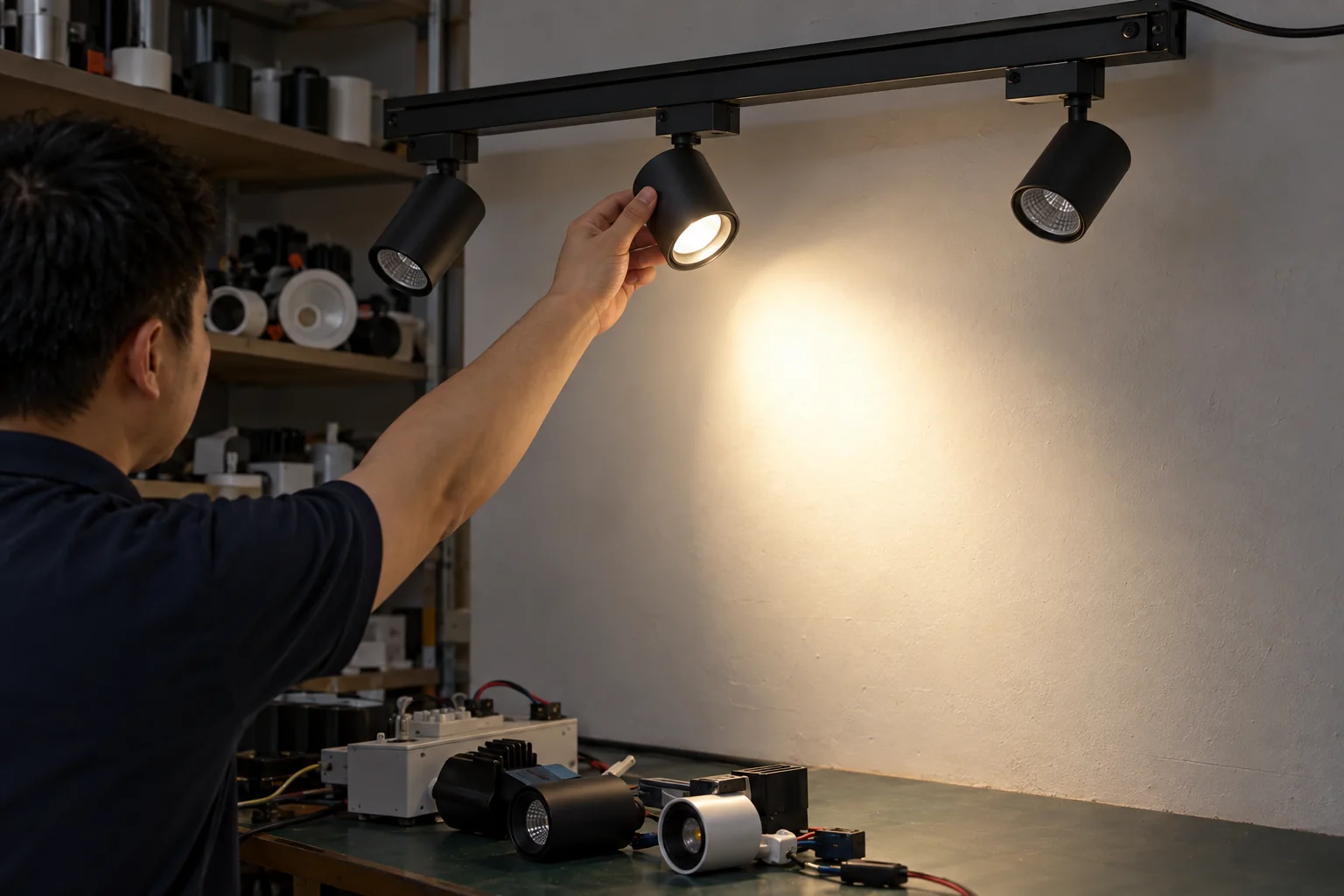
Navigating the global lighting market requires looking deeper than catalog photos and low unit prices. In my factory, we frequently see projects compromised by vague requirements. Let us examine the exact evaluation criteria you need to procure fixtures that perform reliably on site.
Why Is a Reference Image Never Enough When Specifying Commercial LED Lighting?
Sending a reference photo to suppliers feels like a fast shortcut during procurement. However, visual similarity hides critical mechanical tolerances, heat dissipation structures, and ceiling compatibility. Without detailed mechanical parameters, you risk purchasing fixtures that cannot physically install into your project ceiling or track system.
A reference image merely identifies an aesthetic style, not a functional fixture specification. Commercial projects require precise structural data, including ceiling cutout dimensions, recessed clearance depth, mounting clip tension, track system compatibility, and heat sink mass. Without these mechanical details, visually identical fixtures can fail during on-site installation or overheat inside the ceiling plenum.
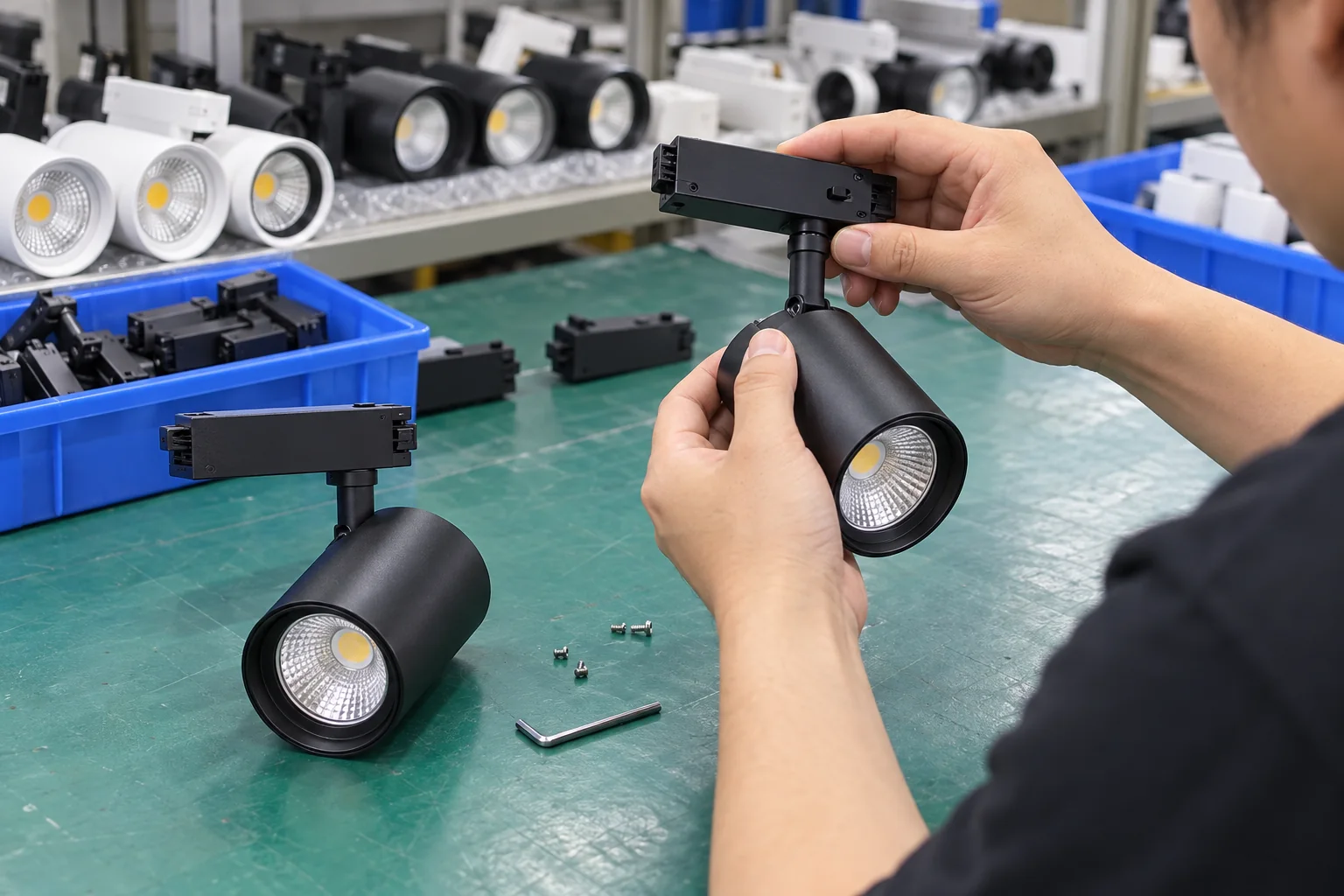
The Mechanical Reality Behind Architectural Lighting
In my daily communication with overseas contractors, I frequently receive inquiries containing only a cropped Pinterest image or a rendered architectural visual. The buyer asks for a unit price for 500 pieces. In one case, a client sent a photo of a minimalist, trimless downlight for a boutique hotel corridor. The image looked clean, but the client did not specify their ceiling structure.
When we asked for structural drawings, we discovered their ceiling plenum had only 65 millimeters of clearance. The fixture shown in their reference photo required a minimum depth of 120 millimeters to house its passive aluminum heat sink. Had they ordered based on the visual design alone, five hundred fixtures would have arrived on site completely unusable.
A complete mechanical specification requires more than diameter. You must clarify several physical parameters before requesting a quotation:
- Cutout and Trim Profiles: Distinguish between trimless plaster-in frames, micro-trim designs, and wide-flange retrofit trims.
- Recessed Void Clearance: Measure the distance between the false ceiling and structural slab, accounting for HVAC ducts and conduit.
- Ceiling Thickness and Material: Specify whether you are installing into 9mm gypsum board, 15mm double drywall, acoustic tiles, or timber slats.
- Track Architecture: If sourcing track spots, define the electrical infrastructure. A 2-wire single-circuit track head will not fit a 4-wire 3-phase European track or a 48V low-voltage magnetic system.1
Specification Brief: Aesthetic Photo vs. Functional Engineering
The table below illustrates the information gap between an image inquiry and a procurement brief:
| Parameter | Reference Image Inquiry | Functional Procurement Brief |
|---|---|---|
| Fixture Type | "Round black downlight" | Deep-recessed architectural downlight |
| Mounting | Appears flush in drywall | Plaster-in trimless frame with adjustable brackets |
| Cutout Dimensions | Unknown / Assumed standard | Exactly Ø75mm with 85mm overall depth |
| Plenum Clearance | Not considered | 100mm maximum accessible depth |
| Heat Dissipation | Not visible | Die-cast ADC12 aluminum passive heat sink |
| Operating Space | Office render | Hotel guestroom corridor with continuous operation |
Always remember that certified installation conditions vary across international markets. Local building codes, fire ratings, and electrical standards require qualified engineering verification on your job site before finalizing mounting profiles.
How Do You Define Technical Parameters for Commercial LED Lighting Beyond Wattage?
Comparing fixtures strictly by wattage and headline lumens creates a false sense of security. Two 15-watt downlights can deliver drastically different visual comfort, beam control, and color accuracy in commercial spaces. Relying only on power ratings often results in uneven illumination, uncomfortable glare, and disappointed interior designers.
Defining commercial LED lighting requires balancing optical performance with specific visual tasks rather than chasing raw wattage. Buyers must specify beam angles, unified glare rating (UGR), color temperature (CCT), color rendering index (CRI and R9 values), and optical accessories like honeycombs. These photometric criteria determine real-world illumination quality and visual comfort.
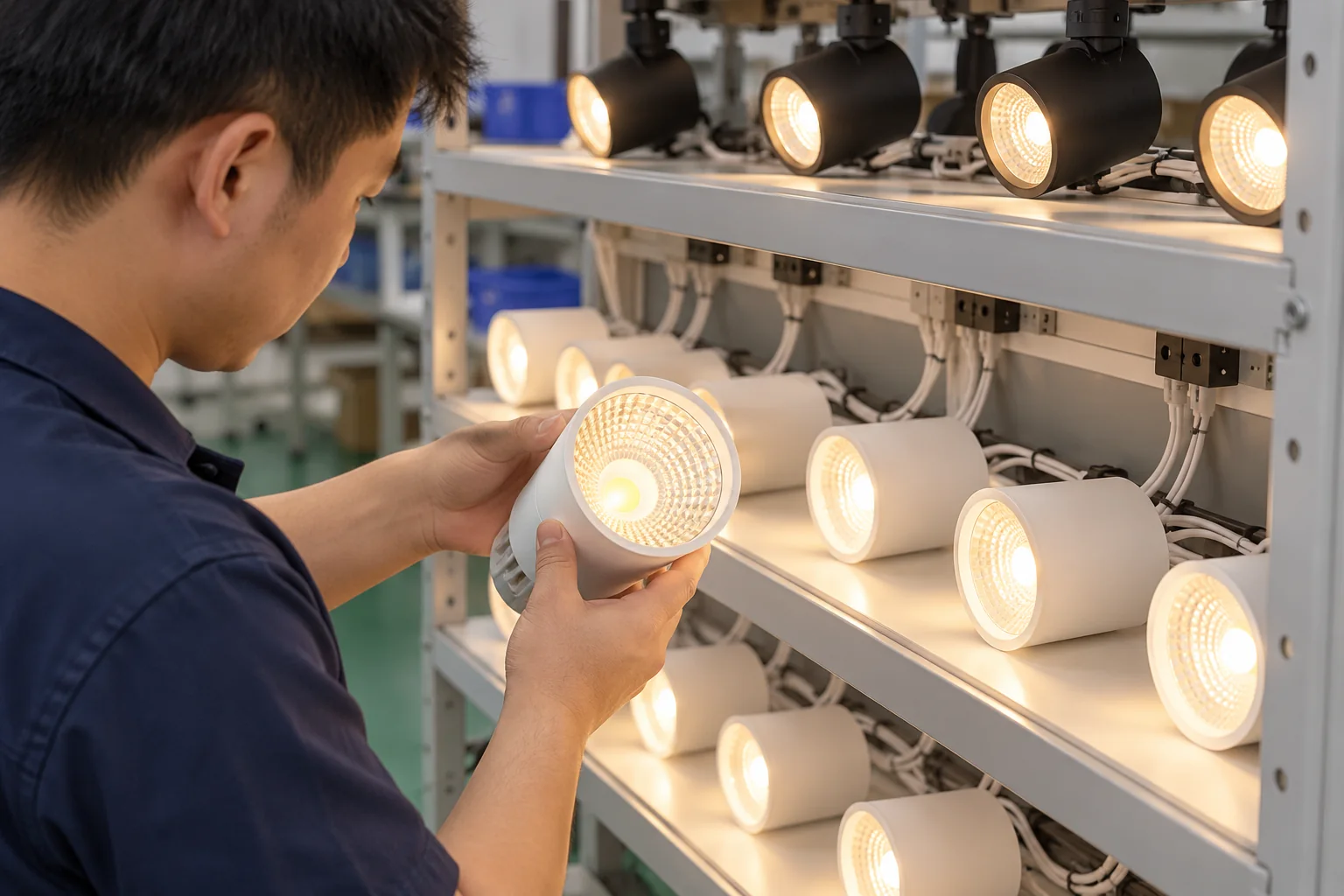
Optical Control and Glare Reduction
Wattage simply measures electrical consumption, not the volume or quality of delivered light. In commercial spaces like retail stores, galleries, and corporate offices, light distribution matters far more than gross lumen output.
A 20W luminaire with a wide, uncontrolled 90-degree reflector will spray light everywhere. This creates intense visual glare on computer monitors and ceiling planes. Conversely, a 20W luminaire engineered with a precision secondary TIR (total internal reflection) lens or deep faceted reflector focuses light directly onto the display merchandise.
To prevent visual discomfort, commercial specifications should target an objective Unified Glare Rating (UGR). For general office workstations, standard guidelines recommend UGR < 19. For high-end hospitality and accent lighting, UGR < 13 is often preferred.2 Achieving these metrics requires:
- Deep Recessed Light Sources: Keeping the LED chip set back at least 30 to 45 degrees from the trim edge.3
- Secondary Anti-Glare Rings: Black, specular, or matte internal baffles that absorb spill light.
- Optical Accessories: Factory-installed honeycomb louvers, frosted diffusion lenses, or oval-beam shapers.
Spectral Quality: Color Temperature and Color Rendering
Color quality transforms how customers perceive high-end interiors. Commercial specifications must establish exact parameters for chromaticity:
- Correlated Color Temperature (CCT): Standard commercial applications range from 2700K (intimate hospitality) to 3000K (retail and warm commercial), 3500K (modern corporate), and 4000K (commercial office and task areas).
- Color Consistency (SDCM): Specify standard deviation of color matching. High-grade commercial fixtures should maintain SDCM < 3 (MacAdam 3-step ellipse) across all production batches to prevent visible color variations between adjacent fixtures.4
- Color Fidelity (CRI / Ra and R9): While standard commercial fixtures often claim Ra > 80, retail and hospitality projects require Ra > 90.5 Most importantly, check the R9 value (saturated red). Cheap chips with high nominal CRI often possess an R9 near zero, rendering wood finishes, fabrics, and skin tones flat and gray. Aim for R9 > 50 for premium interiors.6
Exact illuminance targets (lux levels) and light distribution curves depend on architectural layouts. We recommend working with an independent lighting designer to generate photometric simulation files (.IES or .LDT) before locking your hardware specs.
What Structural and Component Differences Affect Commercial LED Lighting Quality?
Quotations for visually identical commercial fixtures often show dramatic price discrepancies. These cost variances stem directly from internal engineering, raw material choices, and electrical safety components. Ignoring these internal differences exposes your project to premature lumen depreciation, color shift, and catastrophic driver failures.
The primary quality drivers in commercial LED lighting are the thermal management housing, internal LED packaging, and electronic driver quality. Heavy die-cast aluminum dissipates heat far better than thin stamped metal.7 High-grade COB chips and certified constant-current drivers prevent thermal throttling, visible flicker, and premature system failure under continuous commercial operation.
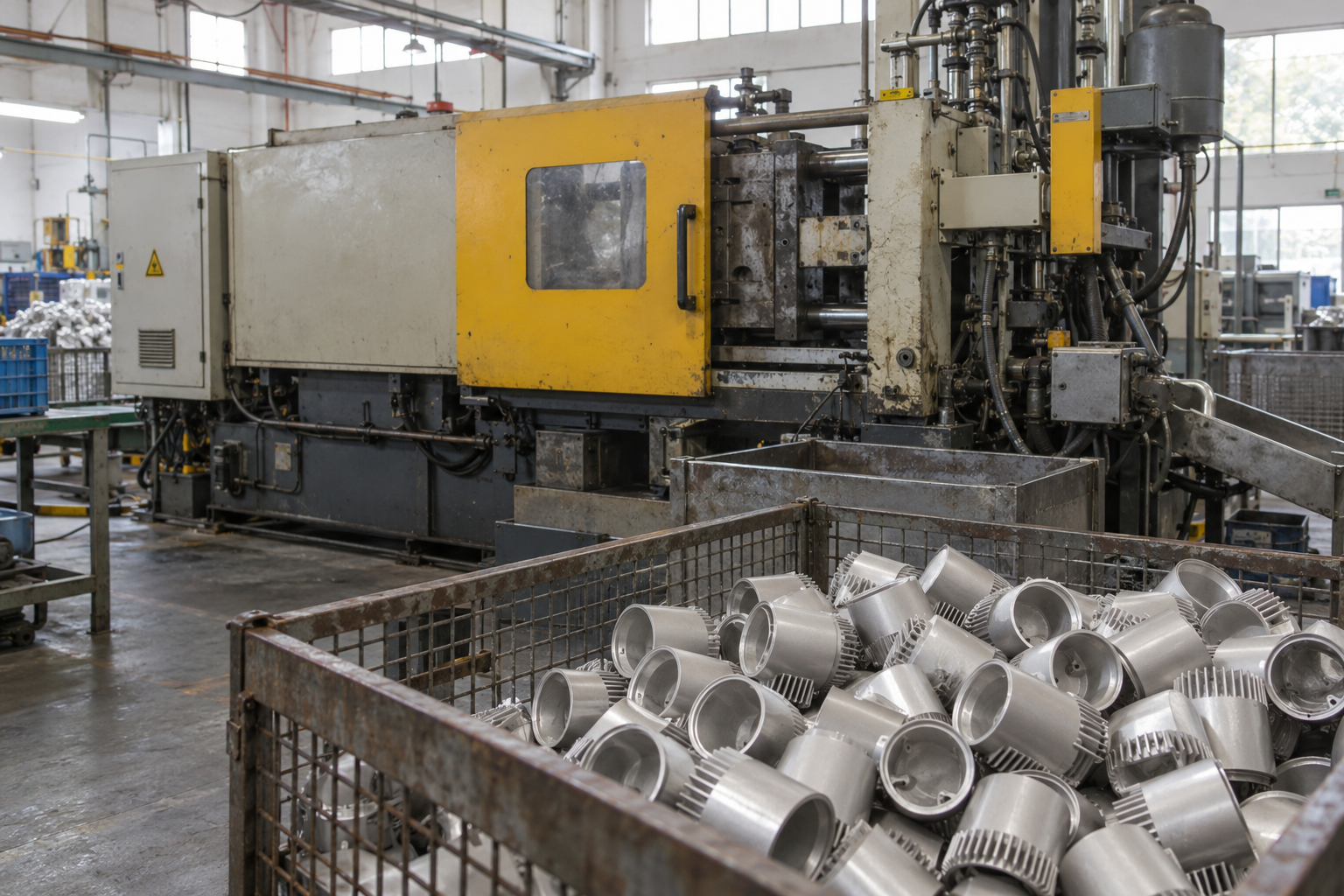
Housing Construction and Thermal Dissipation
The thermal path of a luminaire directly controls the lifespan of its internal electronics. In our production facility, we run our own tooling to manufacture primary bodies from die-cast aluminum alloy (typically ADC12).
Low-cost alternatives flood the market with stamped sheet metal, cold-rolled iron covers, or plastic housings with thin internal aluminum inserts. While stamped metal lowers production cost and shipping weight, it possesses inferior thermal conductivity and reduced surface area.
When an LED chip operates, the junction temperature ($T_j$) must stay below manufacturer limits—often under 85°C.8 Inadequate heat sinks trap heat inside the housing. This accelerates phosphor degradation, causes rapid color shifts, and halves the rated operating lifespan of the luminaire.
The Power Supply: The True Heart of Commercial Reliability
Over 80% of premature field failures in commercial fixtures originate in the electronic driver, not the LED emitter.9 When reviewing factory quotations, look past the housing exterior and inspect the internal electrical bill of materials.
AC Mains Input ---> [ Surge Protection ] ---> [ Rectification & PFC ] ---> [ Thermal & Current Control ] ---> Regulated DC to LEDsA commercial-grade constant-current driver features several vital safeguards:
- Low Ripple Current: Cheap drivers generate high output ripple current (often exceeding 20–30%), resulting in invisible high-frequency flicker that causes eye fatigue and shows banding on smartphone cameras. Commercial drivers should guarantee ripple < 5%.10
- Power Factor (PF) and THD: Look for PF > 0.90 and Total Harmonic Distortion (THD) < 15% to comply with commercial electrical grid standards.11
- Dimming Protocols: Clearly state if your project requires DALI-2, 0–10V, Phase-cut (Triac), or digital low-voltage bus systems. Mismatches here will cause dimming chatter and dead-travel on control sliders.
- Proven Components: Reputable suppliers rely on established driver engineering from brands like Tridonic, Osram, Philips, Lifud, or Boke, matching them to reliable COB emitters like Citizen, Cree, Bridgelux, or Osram.
Production Tier Comparison
| Component / Feature | High-Reliability Commercial Grade | Economy / Cost-Cut Grade |
|---|---|---|
| Housing Material | Heavy die-cast ADC12 aluminum | Thin stamped sheet iron or plastic-clad |
| Heat Dissipation | Engineered vertical fins, passive convection | Minimal surface area, enclosed cavity |
| LED Light Source | Tier-1 COB (Citizen, Bridgelux, Osram) | Unbranded or low-bin commodity SMD/COB |
| Color Consistency | 3-step MacAdam ellipse (SDCM < 3) | 5-step or un-binned (visible CCT shifts) |
| Driver Engineering | Certified, flicker-free (<5% ripple), PF > 0.9 | High ripple (>20%), uncertified, PF < 0.7 |
| Assembly & Testing | Modular wiring, thermal paste, full burn-in | Hand-soldered wires, no aging test |
How Should Buyers Structure Inquiries to Receive Accurate Commercial LED Lighting Quotations?
Broad, open-ended RFQs force manufacturers to make wild assumptions about your expectations. When suppliers guess your requirements, you receive mismatched quotes that make side-by-side price comparison impossible. Structuring your inquiry with precise commercial and technical parameters guarantees transparent, actionable proposals from reputable factories.
To receive accurate commercial LED lighting quotations, provide a detailed procurement brief before asking for pricing. This brief should state target quantities, mechanical installation constraints, required optical parameters, preferred driver protocols, compliance expectations, delivery terms (such as EXW or FOB), and target pricing. Clear parameters allow suppliers to match exact component tiers.
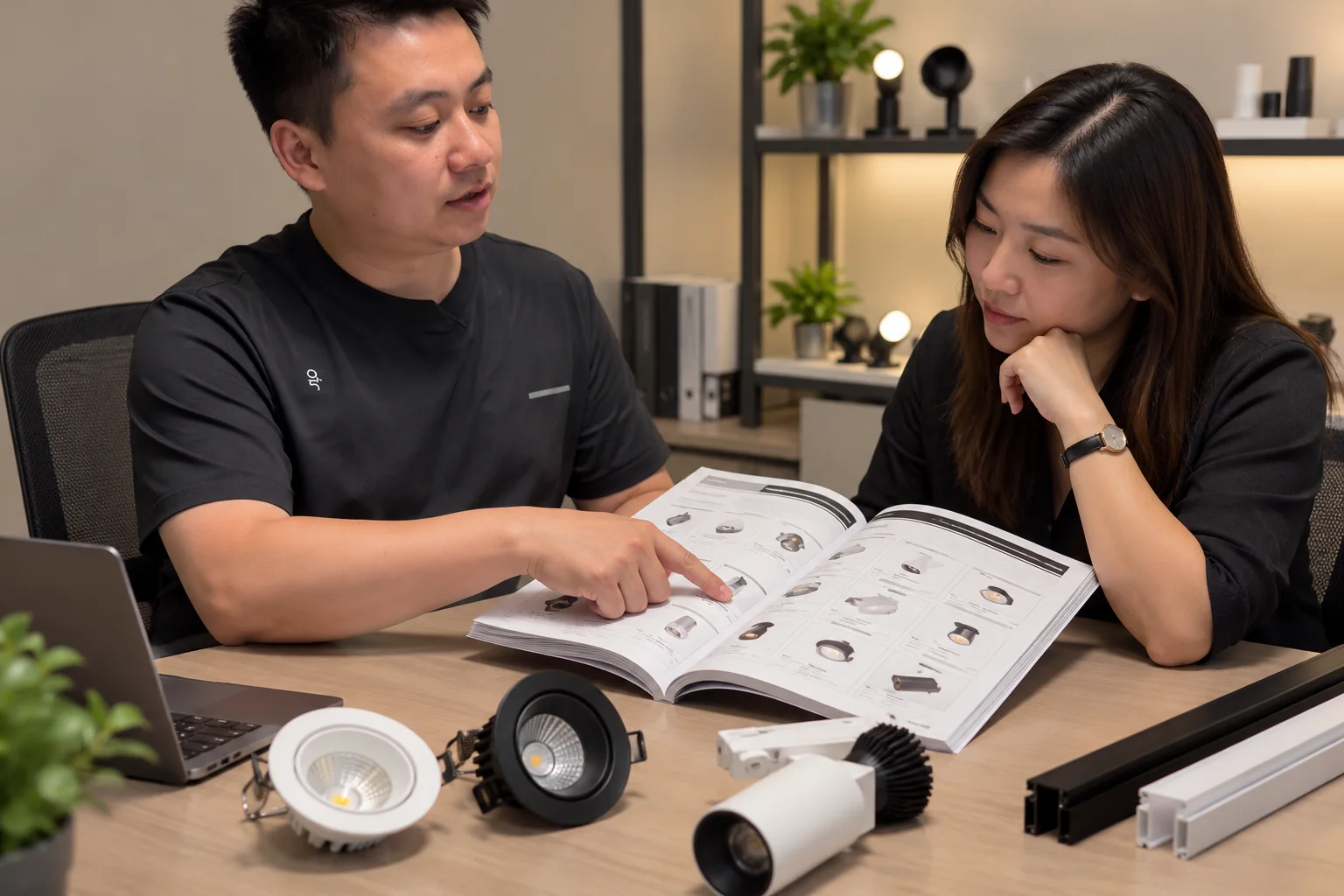
The High Cost of Ambiguous Inquiries
When an inquiry arrives stating simply "quote 1000 pcs 15W LED track light," every manufacturer quotes a different product.
One supplier quotes an economy plastic track head with an unbranded driver. Another quotes a commercial die-cast fixture with a flicker-free Lifud driver. A third quotes a museum-grade fixture with a Citizen COB and a DALI driver. The resulting price quotes range from $6.00 to $32.00 per unit. You cannot evaluate these offers objectively because the underlying engineering assumptions do not align.
The Professional Buyer's Inquiry Checklist
To obtain direct, comparable pricing, build your RFQ using this structured checklist:
- Project Application and Mounting Context: State clearly whether you are supplying an office, a boutique store, or a luxury hotel. Specify the mounting structure (cutout size, ceiling thickness, or track rail type).
- Luminous and Electrical Targets: Provide your target wattage, required delivered lumens, beam angle, CCT, and minimum CRI/R9 values.
- Control and Dimming System: State whether the drivers should be non-dimmable, 0–10V, Phase, or DALI-2.
- Component Preferences: If your client requires specific brands (such as Citizen COB with Tridonic driver), document them upfront.
- Commercial Volume and Terms: State your project batch quantities, required production lead times, and trade term expectations. Standard factory pricing is generally EXW (Shenzhen factory gate), but manufacturers can quote FOB Shenzhen or CIF destination ports upon request.
- Compliance and Documentation: Identify the electrical certifications required for import into your jurisdiction (such as CE, RoHS, CB, or regional equivalents). Note that you should always verify these certificates independently through accredited testing bodies.
By standardizing your inquiry, you filter out brokers who cannot answer technical questions and allow manufacturing partners to engineer the most cost-effective solution within your budget.
How Do Sample Testing and Factory Aging Protect Your Commercial LED Lighting Orders?
Placing a bulk order based solely on digital spec sheets creates massive commercial risk. Even certified components can fail if assembled poorly or operated under extreme thermal loads. Rigorous sample testing and structured factory quality controls are the only reliable defenses against catastrophic job-site failures.
Sample validation and factory aging tests eliminate project risks by verifying mechanical fit, optical performance, and electrical safety before mass production. A standard protocol includes physical bench testing, ceiling mockups, 100% factory aging burn-in for several hours, and pre-shipment video verification. This process catches assembly defects and thermal instability early.
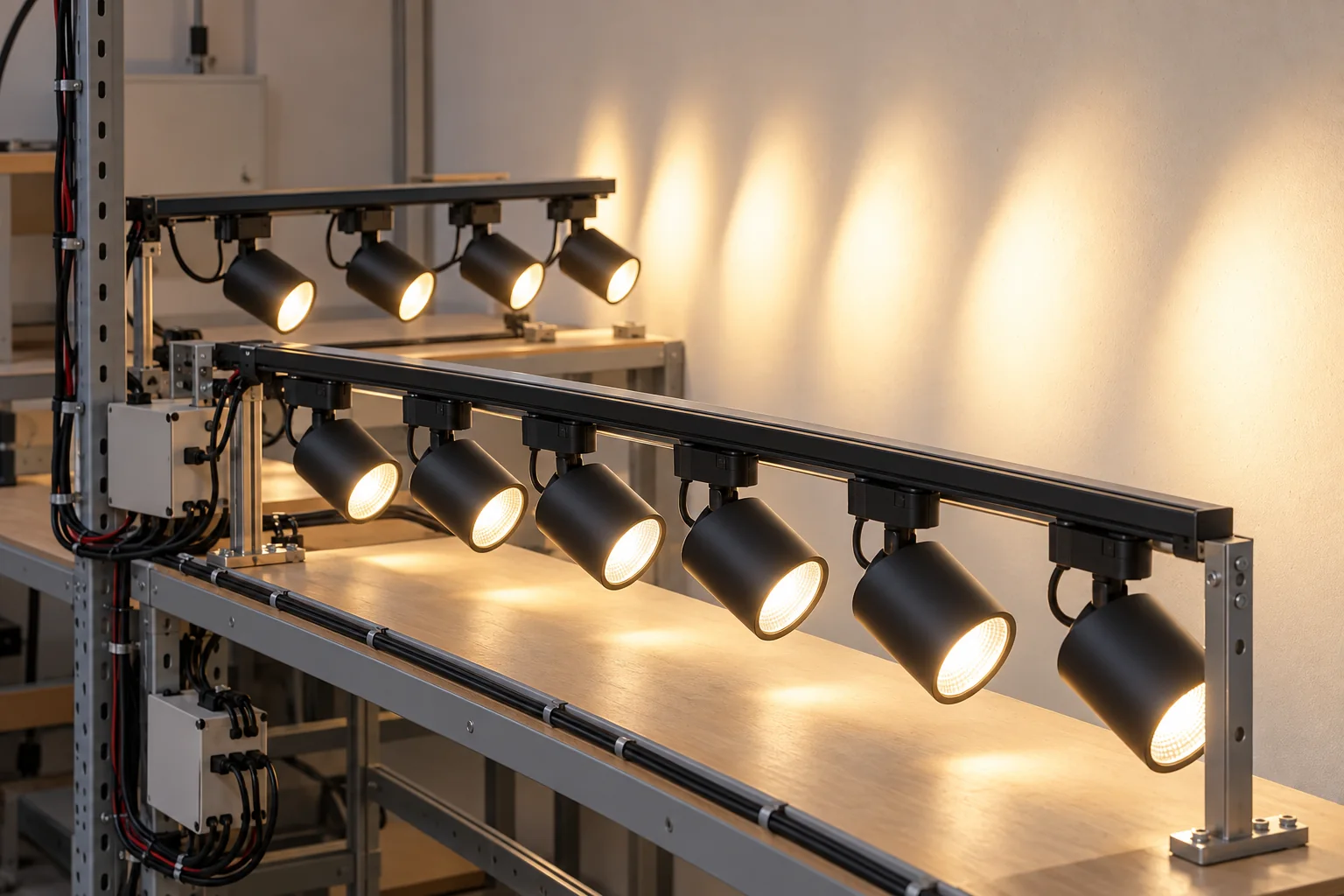
The Sample Evaluation Protocol
Before committing to mass production, order 1 to 2 physical samples for testing. Professional commercial manufacturers charge for project samples and require buyers to cover international freight. This is standard industrial practice that separates serious procurement inquiries from catalog collectors. In our business model, sample fees are refunded against the subsequent commercial bulk order for that same specification.
When your samples arrive, conduct this three-stage evaluation:
- Mechanical Verification: Mount the fixture into an actual mockup ceiling or track section. Check spring clip tension, trim alignment, paint finish consistency, and thermal clearance.
- Optical Bench Inspection: Power the fixture. Inspect the light beam edge on a clean white surface. Look for harsh rings, chromatic aberration (yellow outer halos), or hotspots. Verify dimming behavior down to 1% without audio hum or visible strobing.
- Thermal Spot Check: Run the sample continuously for three hours. Safely feel the housing: the heat sink should feel warm to the touch. If the outer body remains completely cold, the internal thermal interface material may not be transferring heat away from the chip, which spells disaster for lifespan.
Factory Testing and Aging Standards
Mass production requires strict internal quality control gates. The most critical step in LED luminaire manufacturing is the burn-in aging test.
Component Incoming Inspection ---> SMT & Sub-Assembly ---> Full Aging Test (Continuous Burn-in) ---> Electrical & Hi-Pot Test ---> Final Inspection & PackingElectronic components exhibit an "infant mortality" curve—weak solder joints or defective driver capacitors typically fail during the first few hours of continuous operation.12
In our Shenzhen manufacturing facility, we do not ship spot-checked batches. Every finished commercial luminaire passes through a multi-hour aging line running at full electrical load, combined with rapid on/off switching cycles to induce thermal shock. Any fixture with unstable components fails on the test rack, not in your client's finished ceiling.
Before dispatch, ask your supplier to provide pre-shipment inspection photos and burn-in testing videos showing your specific order batch. This transparency ensures that the goods leaving the factory gate match the verified sample specifications.
Frequently Asked Questions
Why do commercial LED lighting manufacturers charge for product samples?
Commercial manufacturers customize samples to your precise electrical, optical, and mechanical specifications. Building 1–2 tailored pieces requires pulling individual components, interrupting production schedules, and conducting separate bench testing. Charging a sample fee covers these initial labor costs and verifies that the buyer has an active, legitimate procurement project.
Can I use indoor commercial LED lighting in wet or outdoor spaces?
Standard commercial fixtures carry an IP20 rating, designed exclusively for dry indoor spaces like offices, retail shops, and hotel corridors. High-moisture areas like commercial kitchens, bathrooms, covered canopies, or outdoor walkways require fixtures rated IP44, IP54, or IP65 with silicone gaskets and moisture-resistant internal drivers.
What dimming system should I specify for commercial lighting projects?
The choice depends on the project control infrastructure. DALI-2 is the global commercial benchmark for large-scale, individually addressable lighting management in hotels and corporate offices. For simple group dimming on smaller budgets, 0–10V or 1–10V analog controls work well. Phase-cut (Triac) dimming is usually reserved for basic retrofits.
How long does a factory aging test take for commercial LED fixtures?
Standard factory aging tests run between 4 and 12 continuous hours, depending on the product family, driver architecture, and client specifications. During this burn-in process, technicians run the fixtures at maximum power and cycle power switches on and off to catch early component failure before final packaging.
Conclusion
Procuring commercial LED lighting successfully is not a matter of matching catalog photos or chasing bottom-dollar unit pricing. It is a systematic process of engineering risk management. By defining structural constraints, prioritizing optical performance, specifying dependable drivers, and requiring 100% factory aging tests, you protect your commercial projects from catastrophic failures and expensive site rework.
Establish your technical criteria early, verify real samples under site conditions, and work with manufacturing partners who prioritize transparent production standards. If you are preparing an indoor commercial project and need reliable, customizable downlights, track lights, linear lights, or magnetic systems, contact our engineering team to review your specifications and prepare functional production samples.
"2 Circuit vs 3 Circuit Track Lighting (Complete Guide)", https://tracklightingworld.com/blog/2-circuit-vs-3-circuit-track-lighting/. Reference material on track lighting systems distinguishes two-wire single-circuit tracks from three-phase four-wire tracks and low-voltage magnetic tracks, which generally require matching heads or adapters because mechanical profiles and electrical contacts differ. Evidence role: definition; source type: encyclopedia. Supports: Define track lighting circuit types and their non-interchangeability.. Scope note: Some manufacturers produce adapters that allow cross-compatibility, so the incompatibility is not absolute across all product lines. ↩
"EN 12464-1 | Lighting products PIL International", https://www.performanceinlighting.com/ww/en/en-12464-1. EN 12464-1 specifies limiting UGR values for indoor workplaces; for offices it commonly sets UGR ≤ 19, while lower values are applied where glare control is more critical, such as hospitality and accent lighting. Evidence role: expert_consensus; source type: institution. Supports: Support UGR limits for office and hospitality lighting.. Scope note: The UGR < 13 value is application-specific and not a single universal legal limit. ↩
"How to Choose LED Downlight Beam Angle: Optical Performance ...", https://www.issuewire.com/how-to-choose-led-downlight-beam-angle-optical-performance-ugr-guide-1875660604869623. Glare-control literature describes recessing the light source and increasing the shielding angle as mechanisms that reduce direct view of the emitter and lower discomfort glare in downlights. Evidence role: mechanism; source type: research. Supports: Explain how recessing the LED source reduces direct glare.. Scope note: The exact 30–45 degree range depends on luminaire geometry, beam distribution, and the glare metric used. ↩
"Color Stability of LEDs: Understanding the Basics", https://www1.eere.energy.gov/buildings/publications/pdfs/ssl/royer_stability_lightfair2014.pdf. Color science and LED binning literature use MacAdam ellipses to quantify chromaticity tolerance; a 3-step ellipse is commonly cited as a practical threshold for reducing visible color differences among adjacent luminaires. Evidence role: expert_consensus; source type: paper. Supports: Support the use of 3-step MacAdam ellipse for color consistency.. Scope note: Perceptibility varies with observer, luminance, and viewing conditions, so SDCM < 3 is not an absolute guarantee. ↩
"Color Rendering Index – CRI Simply Explained", https://1stsourcelighting.com/color-rendering-index-cri-simply-explained/?srsltid=AU7gw4VW7YRuqtxL9oJdI1sugfk4BYdeqPAGtnAlC1XQkJDiBagNGzrW. Lighting design guidance often recommends CRI ≥ 90 for retail and hospitality interiors where accurate color appearance is important, whereas general commercial spaces may accept lower CRI values. Evidence role: expert_consensus; source type: education. Supports: Support higher CRI recommendations for retail and hospitality.. Scope note: This is a design recommendation rather than a uniform regulatory requirement. ↩
"CRI, R9 & R13: What's the difference?", https://www.lightology.com/index.php?module=how_to&sub=cri&srsltid=AU7gw4V5BGbNTiH9cJnWvtJpg84AZ--rNQ8SNg0enZ-gD4R_20EOSASu. Color rendering studies and lighting application guides note that R9, the special index for saturated red, is frequently low in LEDs with high general CRI and that higher R9 values improve rendering of wood, fabrics, and skin tones. Evidence role: general_support; source type: research. Supports: Support the importance of R9 and the target value for premium interiors.. Scope note: There is no universally mandatory R9 threshold; recommendations vary by application and design intent. ↩
"Ultimate Guide for Commercial Lighting Manufacturers (2025)", https://aehtech.com/die-casting-aluminum-led-housing-for-manufacturers/. Thermal engineering literature indicates that aluminum heat sinks have higher thermal conductivity and allow greater surface-area design than thin stamped steel or plastic housings, improving heat removal from LED packages. Evidence role: mechanism; source type: paper. Supports: Explain the thermal advantage of die-cast aluminum.. Scope note: Actual thermal performance depends on geometry, mass, interfaces, and operating conditions, not material alone. ↩
"ENERGY STAR Requirements for the Use of LM-80 Data", https://www.energystar.gov/sites/default/files/ENERGY%20STAR%20Requirements%20for%20the%20Use%20of%20LM-80%20Data%20FINAL%20DRAFT.pdf. LED reliability literature and manufacturer datasheets commonly specify maximum junction temperatures around 85 °C or lower to limit lumen depreciation and color shift. Evidence role: statistic; source type: paper. Supports: Support typical maximum junction temperature in LED reliability.. Scope note: Maximum Tj varies by LED package, drive current, and desired lifetime. ↩
"Mean time between failure | Importance of MTBF", https://www.zgsm-china.com/blog/mean-time-between-failure-of-led-driver-and-the-importance-of-mtbf.html. Field reliability studies of LED luminaires have identified power supply and driver electronics as a leading failure mode, although reported percentages vary by product type and operating environment. Evidence role: statistic; source type: research. Supports: Support driver electronics as a leading failure source.. Scope note: The specific 80% figure may not be supported by a single general statistic. ↩
"Flicker: A review of temporal light modulation stimulus, ...", https://www.energy.gov/sites/default/files/2023-05/ssl-miller-etal-2022-LRT-flicker-review-tlm-stimulus-response.pdf. Research on temporal light modulation indicates that ripple current can produce flicker and stroboscopic effects, and low ripple is a common design objective for flicker-sensitive applications. Evidence role: mechanism; source type: research. Supports: Explain the relationship between ripple current and flicker.. Scope note: The specific <5% ripple target is not a universal regulatory limit; thresholds depend on frequency, modulation depth, and viewer sensitivity. ↩
"IEC 61000-3-2", https://en.wikipedia.org/wiki/IEC_61000-3-2. International electrotechnical standards such as IEC 61000-3-2 limit harmonic current emissions for lighting equipment, and commercial specifications commonly require power factor above 0.90 and THD below 15% to reduce grid distortion. Evidence role: expert_consensus; source type: institution. Supports: Support PF and THD limits for commercial lighting.. Scope note: Exact limits depend on equipment power rating, class, and regional rules. ↩
"Determining the effect of burn-in process on reliability ...", https://pure.psu.edu/en/publications/determining-the-effect-of-burn-in-process-on-reliability-of-x7r-m/. Reliability engineering describes a bathtub curve in which early-life failures, sometimes called infant mortality, are concentrated in the initial operating period and are reduced by burn-in or screening. Evidence role: mechanism; source type: education. Supports: Explain infant mortality and the rationale for burn-in.. Scope note: The duration of early-life failure period varies by component and manufacturing quality. ↩