Finding the right architectural balance between fixture visibility and spatial illumination can challenge even seasoned procurement teams. Specifying a substandard LED track light black fixture often results in scuffed powder coating, noticeable glare against exposed ceilings, or premature diode failure under dense thermal loads. You can eliminate these costly project setbacks by understanding how fixture housing materials, surface finishes, and optical controls interact within commercial environments.
An LED track light black fixture is best specified for dark or exposed architectural ceilings—such as painted open plenums, high-end retail boutiques, hospitality venues, and galleries—where light fixtures must blend into the background. It delivers high-contrast visual merchandising without reflective glare, provided the housing uses electrostatic powder-coated die-cast aluminum for optimal thermal dissipation and durability.
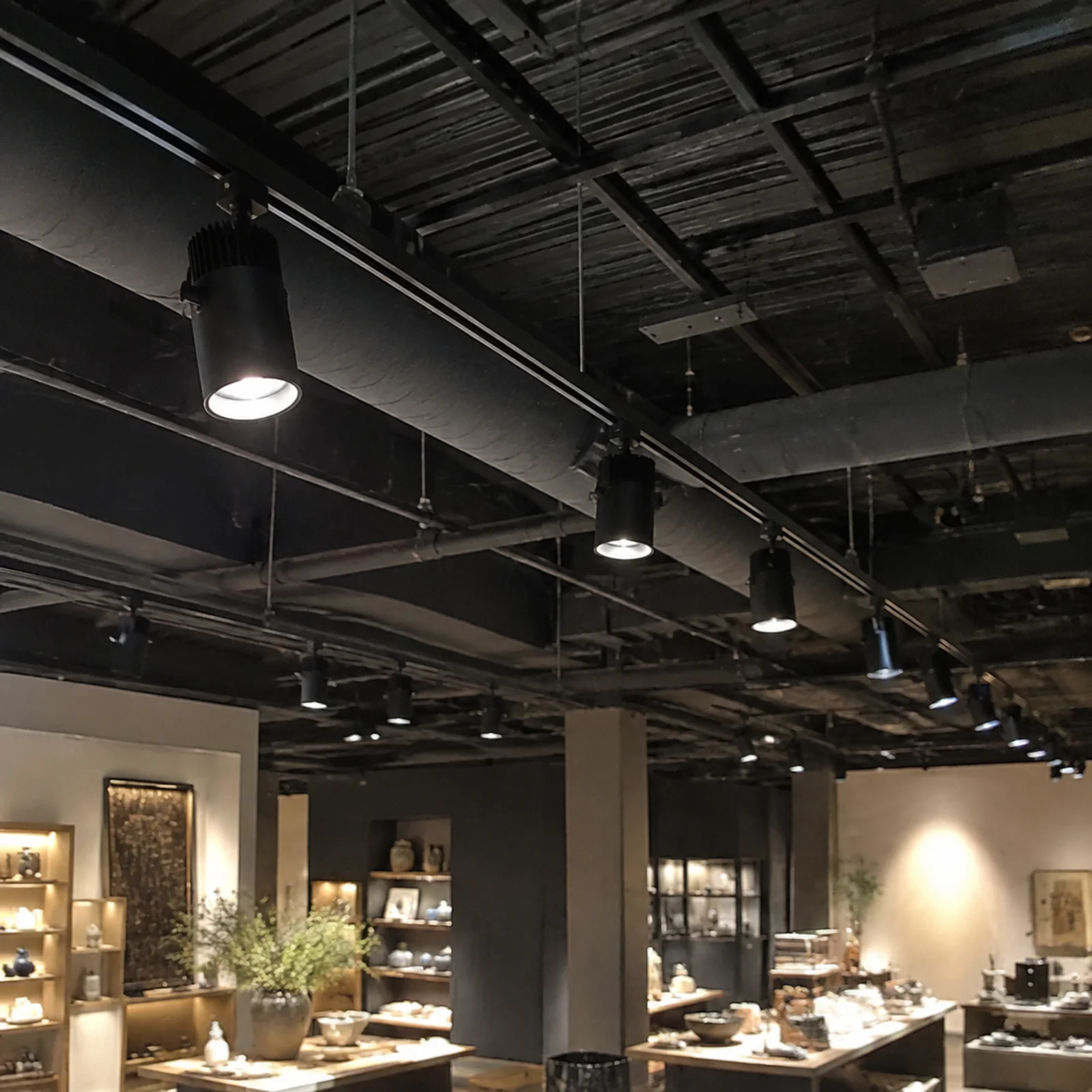
While white housings remain the standard choice for typical drop-tile ceilings, dark industrial layouts present entirely different operational demands. Let us examine the manufacturing realities, optical considerations, and mechanical details you must evaluate before issuing a purchase order for black commercial track fixtures.
Why Is Commercial Demand Growing for an LED Track Light Black?
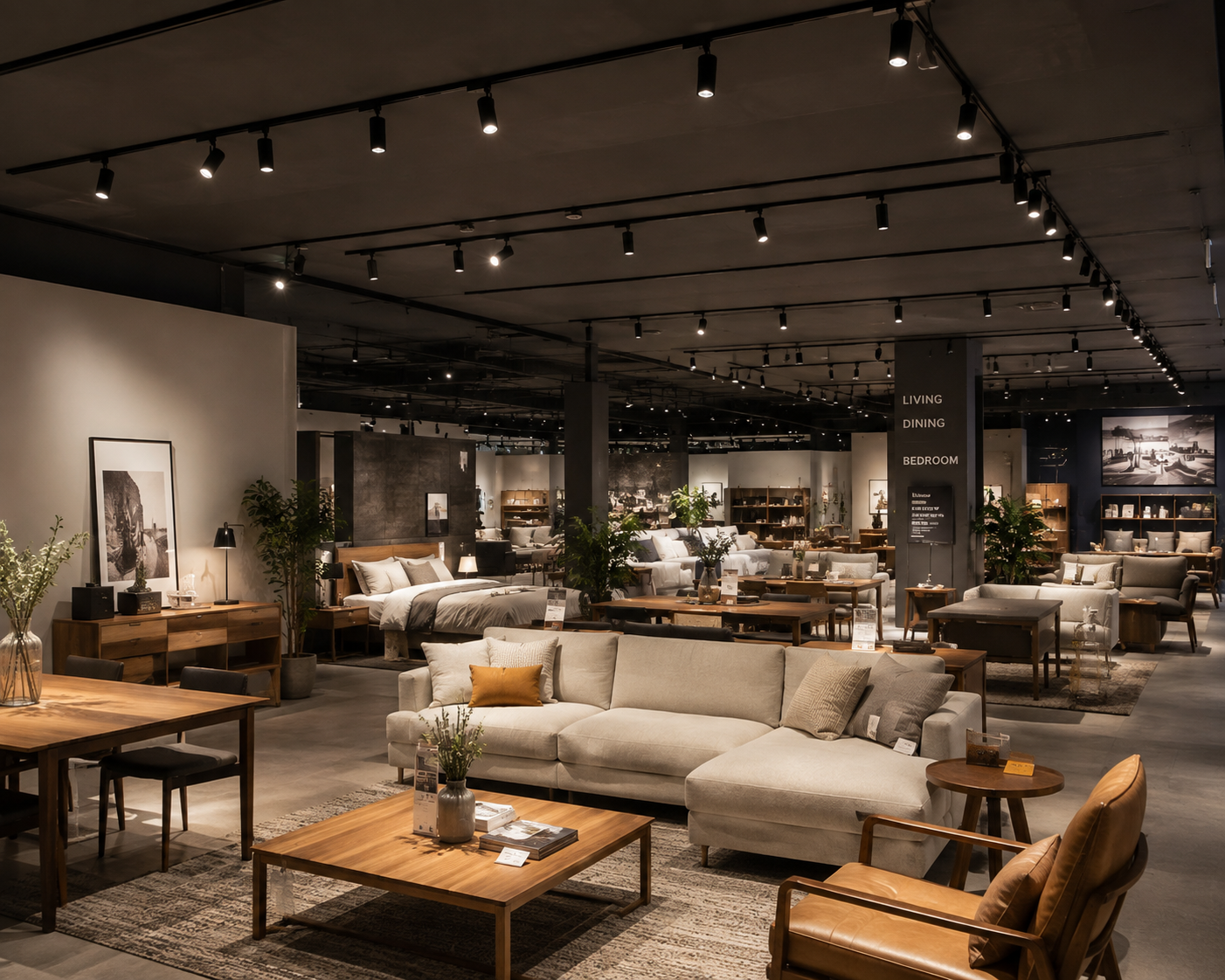
Procurement teams often struggle to balance functional ambient brightness with sophisticated interior aesthetics in modern commercial renovations. When clients demand industrial open ceilings with painted ductwork, standard white luminaires create distracting visual clutter across the upper room volume. Choosing an architectural dark finish resolves this challenge by visually concealing the luminaire hardware while directing the visitor's focus downward toward merchandise and feature displays.
Demand for an LED track light black fixture stems directly from the rise of exposed, dark-sprayed ceilings in modern hospitality, commercial office spaces, and upscale retail stores. Accounting for roughly 30% to 35% of commercial track volume, black fixtures visually recede into open ceiling plenums, providing punchy accent lighting without drawing attention to the hardware overhead.
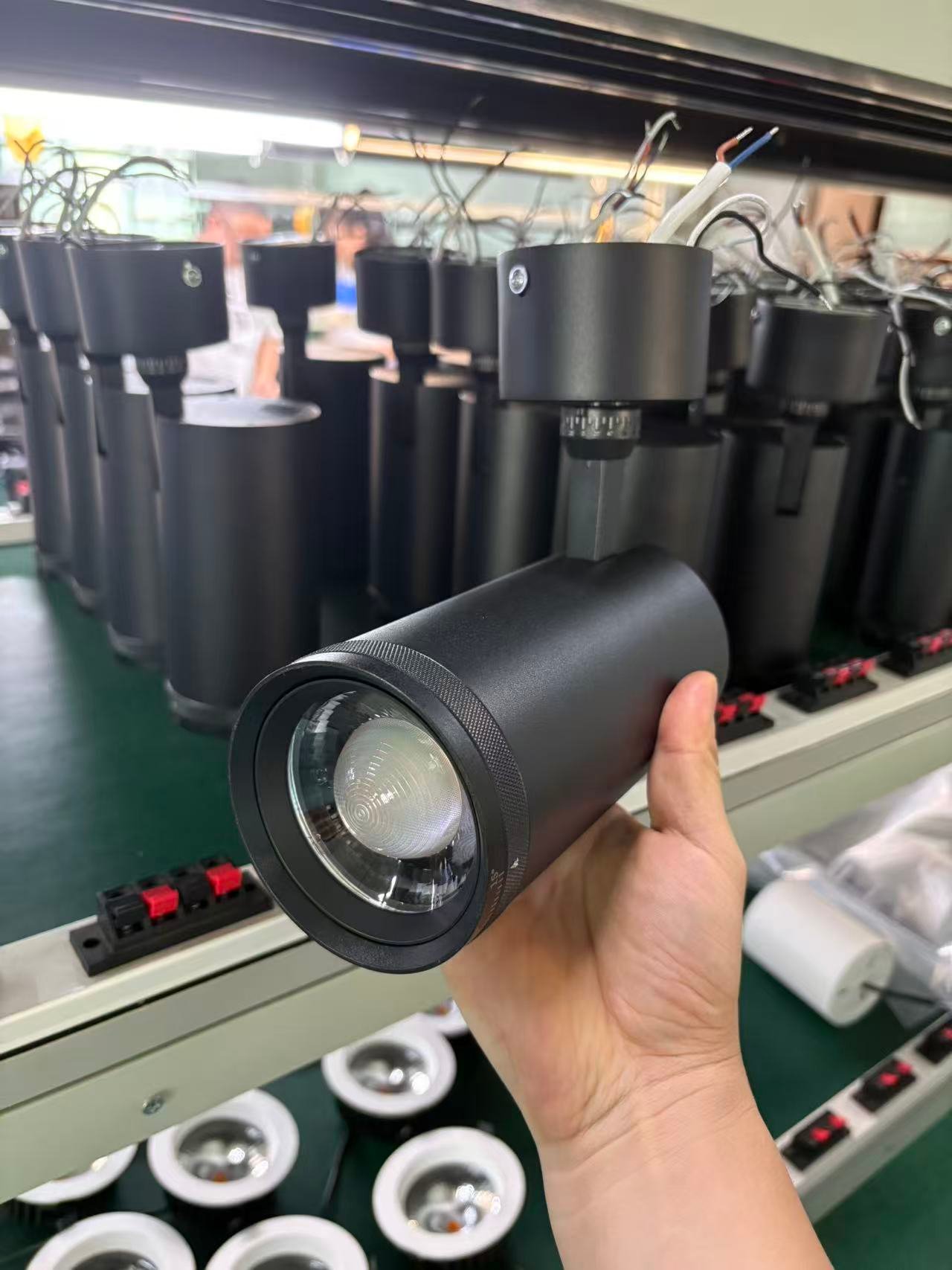
Across our commercial production lines, white fixtures still dominate overall volume at approximately 60% to 70%. White luminaires remain the pragmatic choice for standard acoustic tile or plasterboard ceilings where the lighting package must disappear against a bright surface. However, the black fixture segment represents a rapidly expanding 25% to 35% of our monthly assembly schedule, while custom shades like bronze, silver, or gold remain niche requests under 5%.
Shifting Ceiling Architecture in Retail and Commercial Design
The structural transition from closed drop ceilings to open plenums fundamentally altered luminaire procurement:
- Open-Plenum Spraying: Designers paint exposed metal decking, conduit runs, and HVAC ductwork in matte charcoal or black. A white track head against that backdrop looks like an accidental oversight.
- Graphic Contrast and Rhythm: In contemporary coffee shops, apparel flagship stores, and hotel lobbies, black track runs serve as intentional architectural lines that frame seating zones or retail aisles.
- Merchandise Isolation: Dark track heads reduce upward visual distraction, training consumer attention purely on high-margin product displays below.
Ceiling Environment vs. Typical Housing Specification:
├── Suspended Drop Ceiling (Acoustic Tile) ──> 90% White Fixtures
├── Painted Drywall Ceiling (Off-White)   ──> 80% White / 20% Black (Accent)
└── Exposed Open Plenum (Industrial Dark)  ──> 95% Black Fixtures
When evaluating your bill of materials, do not treat black as a universal default. We regularly advise contractors to reserve black housings for environments where ceiling reflectance is deliberately suppressed.
How Does Thermal Dissipation Affect an LED Track Light Black?
High-power COB chips generate concentrated heat that quickly destroys sensitive driver electronics and degrades lumen output over time1. In a dark luminaire, improper finish chemistry combined with poor heat sink design accelerates junction temperature spikes. You can safeguard your project lifespan by pairing precision-cast aluminum heat sinks with heat-tolerant coating formulations rather than accepting thin, cosmetic paint layers.
An LED track light black finish influences thermal radiation differently than white coatings, but internal conduction matters far more. To prevent premature lumen depreciation, the fixture must utilize high-purity die-cast aluminum2 with engineered cooling fins, coated in high-adhesion electrostatic thermoset powder that withstands prolonged operating temperatures above 65°C without peeling, blistering, or off-gassing3.
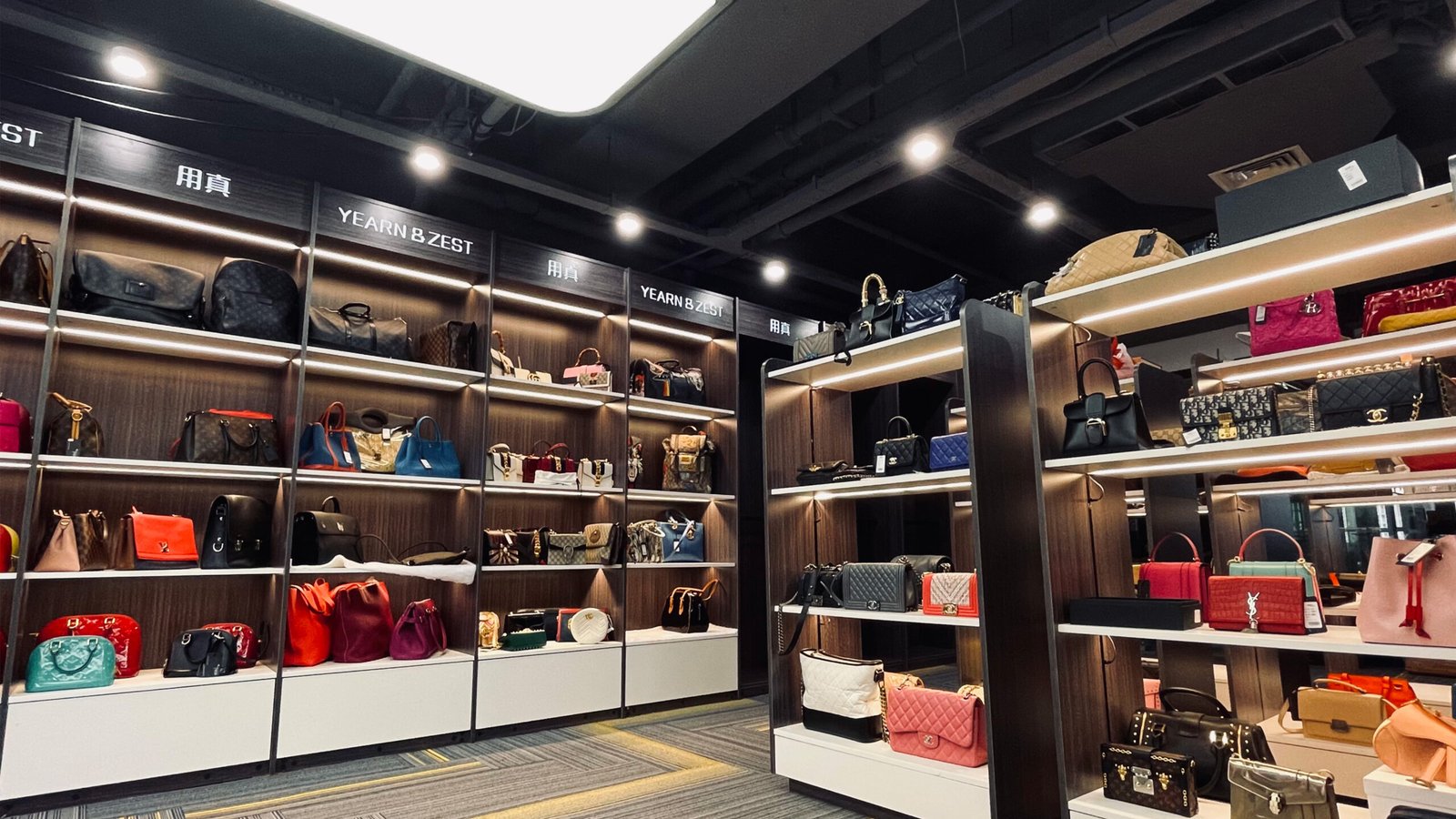
When we run aging tests on our factory floor, housing surface temperatures on 30W to 40W track heads routinely reach 55°C to 65°C under continuous 24-hour operation. The structural integrity of the metal and the chemical resilience of the surface layer determine whether that fixture lasts for 50,000 hours4 or suffers thermal failure within months.
Wet Spray vs. Electrostatic Powder Coating
Many cut-rate suppliers reduce manufacturing costs by applying liquid wet paint over cheap extruded aluminum or unrefined alloys. This shortcuts durability in three major ways:
| Engineering Parameter | Cheap Wet-Spray Coating | Electrostatic Powder Coating |
|---|---|---|
| Coating Thickness | 15–25 microns (uneven) | 60–90 microns (uniform) |
| Scratch Resistance | Prone to transit and tool gouges | High pencil hardness (≥2H)5 |
| Thermal Aging (500 hrs) | Yellowing, micro-cracking, peeling | Zero color drift, intact adhesion |
| Die-Cast Adhesion | Peels easily on corners/fins | Cross-hatch adhesion Grade 0 (ISO)6 |
| Heat Dissipation Impact | Inconsistent thermal radiation | High emissivity, uniform spread |
During site installation, electricians frequently twist, slide, and re-aim fixtures along the rail. Cheap liquid paint scratches instantly when an installer's tool or track edge rubs against the barrel. In contrast, electrostatic powder coating bonds to the die-cast substrate through high-temperature curing, resisting scuffs and preserving the clean, matte black appearance throughout the project's life cycle.
Which Optical Configurations Work Best for an LED Track Light Black?
Lighting dark-ceiling interiors with wide, unfocused flood beams produces excessive ambient wash and washed-out contrast. This ruins the intimate mood of the venue and creates offensive glare for shoppers and diners. Selecting deep-set secondary optics with matched beam spreads resolves this problem by placing the illumination strictly on target displays while keeping the primary light source virtually invisible.
An LED track light black fixture requires precise optical control—such as deep-recessed COBs, secondary faceted reflectors, or TIR lenses7—to achieve high target lux without ambient spill. Anti-glare accessories like black honeycomb louvers or internal snoots keep the Unified Glare Rating (UGR) below 198, which is crucial when fixtures hang against dark ceilings.
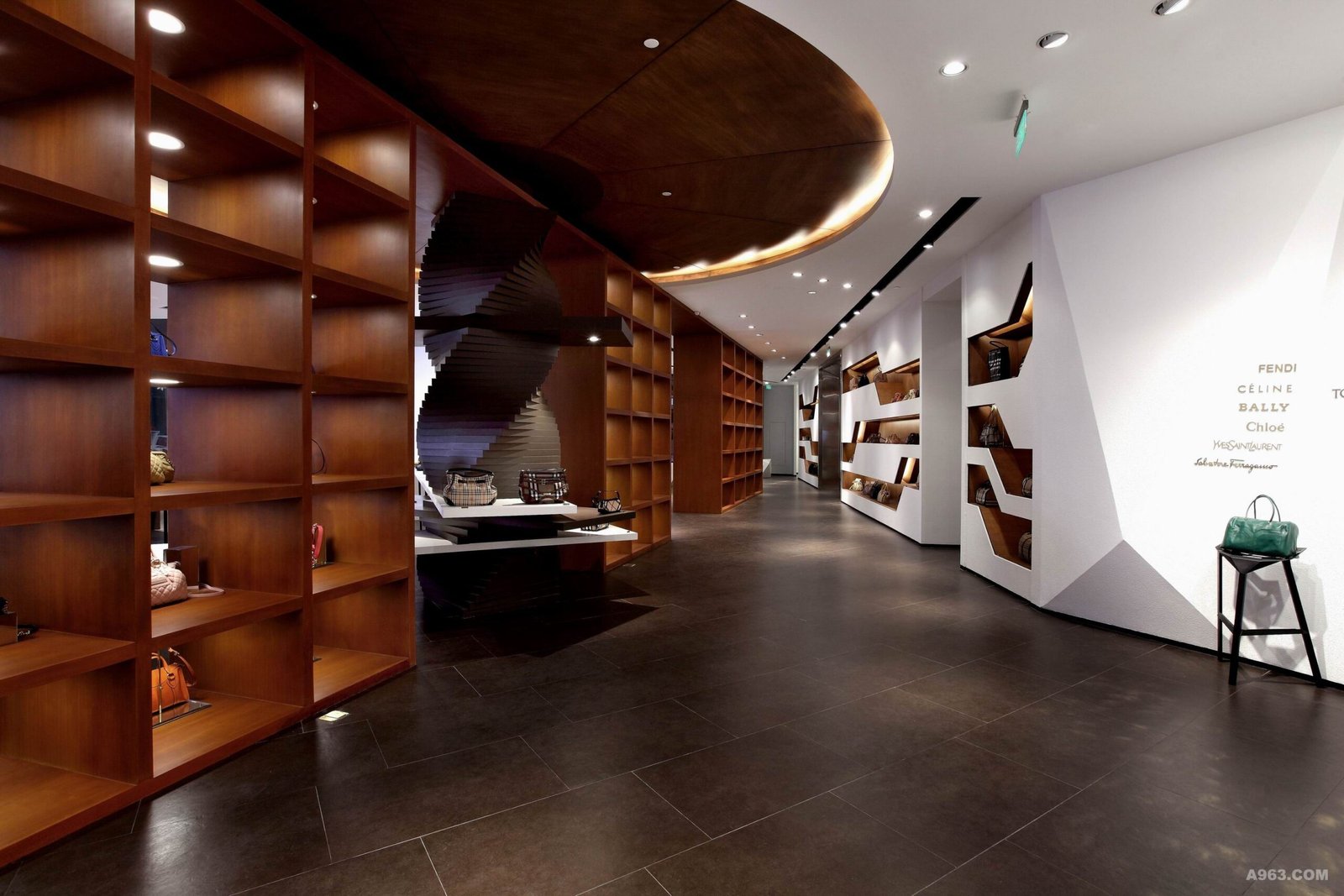
A frequent procurement mistake we witness among overseas project buyers is chasing raw lumen output rather than optical precision. In a bright office with white drop tiles, broad-beam floodlights function acceptably. However, in an exposed black ceiling, high lumen output with poor beam cutoff creates blinding peripheral glare.
The Role of Secondary Beam Control
To preserve the drama of a dark architectural ceiling, you need deliberate beam distribution:
- Narrow Spot (15° to 24°): Ideal for pinpoint window displays, fashion mannequins, or gallery artwork mounted against accent walls.
- Medium Flood (30° to 38°): Best suited for retail shelving units, restaurant dining tables, and checkout counters where wider coverage is needed without spilling into circulation aisles.
- Deep-Recessed Architecture: Recessing the LED chip 20mm to 35mm behind the front bezel shields the eye from direct view of the diode at natural viewing angles9.
- Black Honeycomb Snoots: Adding an integrated matte-black louver eliminates secondary reflections off the interior bezel ring, providing a truly quiet ceiling.
Standard Bezel (High Glare) vs. Deep-Recessed Black Optic (Low Glare):
[ Flat Bezel ] ──> Wide Spill ──> Eye sees raw COB at 45° angle (Distracting)
[ Deep Recess ] ──> Cutoff Angle ──> Light hits target only; ceiling stays dark
By specifying precision secondary optics on your black fixtures, you achieve the contrast ratios that high-end hospitality and retail clients demand.
How Do Mechanical Tolerances Impact an LED Track Light Black?
Loose adapter connections cause flickering, poor grounding, and visible damage along dark track sections. When plastic track adapters use brittle polymers or oversized copper contact pins, installing them can scar the black finish on the inside of the rail. You can prevent these installation failures by matching your fixtures with precisely molded adapters that lock securely into the specified track profile.
Mechanical tolerances dictate both electrical safety and aesthetic longevity. Because black track systems instantly display metal scratches or misaligned housings, track adapters must feature flame-retardant polycarbonate moldings, smooth copper conductor tabs, and verified track standard compatibility (2-wire, 3-wire, or 4-wire/3-circuit) prior to bulk rollout.
A client once showed me a completed showroom project where an installer had forced generic adapters into an imported 3-circuit track system. The ill-fitting pins scraped the internal black powder coating down to bare aluminum, leaving bright silver gouges visible from the retail floor. The contractor had to repaint sections of the track by hand.
Critical Track Adapter Checks Before Ordering
Before placing bulk orders for black track systems, verify these mechanical parameters:
- Track Wire Standard Alignment: Confirm whether your project requires 1-phase 2-wire, 1-phase 3-wire, or 3-phase 4-wire (European standard 3-circuit) configurations10. Never assume track standards interchange seamlessly across regional boundaries.
- Adapter Material Composition: Specify virgin Polycarbonate (PC) over recycled ABS plastics. Recycled plastics turn brittle under continuous internal driver heat11, causing adapter locking levers to snap during post-handover repositioning.
- Rotational Firmness: Ensure the horizontal rotation (typically 350°) and vertical tilt (typically 90°) hold their position firmly under mechanical tension without slipping down over time.
- Factory Insertion Testing: Request that your manufacturing partner test adapter samples directly in your exact rail brand (e.g., Global, Nordic, or custom OEM profiles) prior to packaging the full run.
Frequently Asked Questions
Does an LED track light black housing run hotter than a white one?
Under identical indoor ambient conditions, a black powder-coated housing radiates thermal energy marginally better than a gloss white surface12, but it also absorbs slightly more ambient radiant heat. Internal aluminum heat sink mass and thermal interface pad quality matter significantly more to diode longevity than outer surface color.
How do I prevent black track light housings from scratching during installation?
Specify electrostatic powder coating with an adhesion rating verified by ISO cross-hatch standards instead of basic wet spray. Ensure installation crews clean the track interior before inserting adapters and engage the locking dials only after the fixture sits fully seated inside the rail.
Which ceiling types are best suited for an LED track light black?
Black track systems perform best on exposed industrial ceilings, dark-sprayed open plenums, natural concrete slabs, wood-slat architectural ceilings, and moody interior schemes typical of boutique hospitality, fashion retail, and museum galleries where high visual contrast is desired.
Can I order samples to verify track rail compatibility?
Yes. Professional manufacturers support 1 to 2 piece sample production runs. Because track rail profiles vary between 2-wire, 3-wire, and 4-wire European platforms, ordering sample heads to test mechanical fit, electrical contact, and powder coat finish against your project rail is an essential procurement step.
Conclusion
Specifying an LED track light black is an architectural and engineering decision that delivers striking contrast, quiet ceilings, and focused illumination when executed correctly. By moving beyond bare spec sheets and evaluating die-cast thermal dissipation, electrostatically applied powder coatings, optical beam cutoff angles, and adapter mechanical tolerances, you ensure your commercial installation performs reliably for years. As a direct manufacturer with proprietary die-cast tooling, comprehensive aging procedures, and 100% finished-goods inspection, we invite contractors and project specifiers to contact our engineering team to request sample evaluations and tailor custom commercial track lighting packages for upcoming projects.
"Product Level Accelerated Lifetime Test for Indoor LED ...", https://www.lamar.edu/engineering/_files/documents/mechanical/dr.-fan-publications/2013/Koh%20Lumen%20Depreciation%20EuroSimE%202013.pdf. Illuminating Engineering Society standard TM-21-19 provides the mathematical framework linking sustained junction operating temperatures to accelerated luminous flux degradation in solid-state emitters. Evidence role: mechanism; source type: institution. Supports: Standardized lumen maintenance models demonstrate that elevated pn-junction temperatures accelerate semiconductor degradation and lumen decay.. ↩
"Impact of Thermal Dissipation on the Lighting Performance ...", https://pmc.ncbi.nlm.nih.gov/articles/PMC8776062/. Thermal management reviews in LED luminaire engineering note that standard die-casting alloys such as ADC12 and A380 offer thermal conductivities around 96 W/m·K, providing adequate conduction to keep diode junction temperatures within operational limits. Evidence role: mechanism; source type: paper. Supports: Common aluminum die-casting alloys offer thermal conductivities of approximately 90–120 W/m·K, enabling effective heat conduction from diode substrates.. Scope note: Die-cast alloys possess noticeably lower thermal conductivity than extruded aluminum (such as 6063-T5, ~200 W/m·K), necessitating thicker base sections or expanded fin geometry. ↩
"Powder coating", https://en.wikipedia.org/wiki/Powder_coating. Coatings chemistry data indicates that fully cured polyester and epoxy-polyester hybrid powder systems possess glass transition and continuous service ratings exceeding 100°C, providing stability against thermal delamination at 65°C luminaire housing temperatures. Evidence role: general_support; source type: research. Supports: Cross-linked thermoset powder coatings retain mechanical integrity and surface bonding well beyond 100°C continuous service.. ↩
"Solid State Lighting Reliability from Failure Mechanisms ...", https://www.academia.edu/5538510/Solid_State_Lighting_Reliability_from_Failure_Mechanisms_Perspective_A_Review_of_Related_Literature. IES LM-80-15 establishes standard testing protocols for measuring LED lumen maintenance over 6,000 to 10,000 hours, from which 50,000-hour L70 longevity projections are derived via TM-21 extrapolation. Evidence role: expert_consensus; source type: institution. Supports: The 50,000-hour life benchmark is standardized around L70/B50 metric thresholds under specified case temperature limits.. Scope note: Extrapolations assume consistent operating currents and environmental boundary conditions that may fluctuate in field installations. ↩
"ASTM D3363 is a coating hardness evaluation test", https://www.micomlab.com/micom-testing/astm-d3363/. ASTM D3363 standardizes the pencil lead test method for film hardness, where thermoset architectural powder coatings typically specify a minimum gouge hardness threshold of 2H. Evidence role: definition; source type: institution. Supports: Architectural powder coatings on metallic substrates are classified for scratch and gouge resistance according to pencil hardness scales.. ↩
"Cross-Cut Test: Standards & Selection Guide", https://erichsen.de/en/service/erichsen-academy/knowledge-base/surface-testing/cross-cut-test-standards-selection-guide/?srsltid=AU7gw4WpN36Zofc0nQ1-ssR1qZSRp1zAIi8KXmiC6teYKxIOBrUXdfDA. ISO 2409 defines the cross-cut adhesion evaluation method for painted and powder-coated surfaces, designating Class 0 when zero percent of the latticed test area detaches from the substrate. Evidence role: definition; source type: institution. Supports: ISO Grade 0 defines the highest level of coating adhesion, where the edges of the lattice cuts remain completely smooth without flaking.. ↩
"LED beam shaping lens based on the near-field illumination", https://opg.optica.org/fulltext.cfm?uri=oe-17-26-23449. Optical engineering analyses confirm that molded polymer TIR lenses capture a larger fraction of emitted LED flux than conventional faceted reflectors, allowing tight collimation and sharp beam cutoffs. Evidence role: mechanism; source type: paper. Supports: TIR optics combine refraction and reflection within a single dielectric optic to achieve narrow, well-collimated beam profiles with minimal peripheral spill.. ↩
"Discomfort glare in interior lighting", https://cie.co.at/publications/discomfort-glare-interior-lighting. CIE standard 117-1995 and European standard EN 12464-1 identify a Unified Glare Rating of 19 or lower as the benchmark threshold for preventing discomfort glare in commercial and reading environments. Evidence role: expert_consensus; source type: institution. Supports: A UGR limit of 19 is the international compliance ceiling for visually demanding commercial tasks and low-glare indoor spaces.. ↩
"Electric light glare control", https://standard.wellcertified.com/v21/light/electric-light-glare-control. The Illuminating Engineering Society defines luminaire cutoff and shielding angles as the angular threshold measured from nadir beyond which the primary luminous element is occluded by housing geometry. Evidence role: expert_consensus; source type: institution. Supports: Physical luminaire cutoff angles are standard engineering metrics for preventing direct high-luminance source visibility within normal fields of view.. ↩
"IEC 60570:2003", https://webstore.iec.ch/en/publication/2513. IEC 60570 specifies performance and construction safety standards for track systems supplying luminaires, defining the electrical conductor interfaces used in European three-phase, three-circuit rails. Evidence role: definition; source type: institution. Supports: IEC/EN 60570 standardizes multi-circuit track dimensions, conductor pinouts, and grounding arrangements for European track systems.. ↩
"Relative thermal index", https://en.wikipedia.org/wiki/Relative_thermal_index. Polymer degradation studies indicate that butadiene phases in ABS undergo thermo-oxidative embrittlement under continuous exposure to elevated operating temperatures (50–70°C), whereas virgin polycarbonate maintains structural elasticity. Evidence role: mechanism; source type: paper. Supports: Continuous elevated temperatures induce cross-linking and chain scission in ABS, resulting in significant loss of impact resistance compared to high-RTI polycarbonate.. Scope note: Aging rates depend heavily on specific antioxidant additives and the virgin-to-regrind blending ratio. ↩
"Improvement of the Heat-Dissipating Performance of Powder ...", https://pmc.ncbi.nlm.nih.gov/articles/PMC7362242/. Heat transfer literature demonstrates that non-metallic surface coatings, including both black and white thermoset powder formulations, exhibit high infrared emissivity (typically ε ≈ 0.85–0.92), rendering radiative performance differences minor compared to conduction and natural convection. Evidence role: mechanism; source type: paper. Supports: Radiation contribution in natural convection heat sinks depends on surface emissivity rather than visible color, though matte finishes can yield minor emissivity variations.. Scope note: The emissivity difference between black and white non-metallic coatings is negligible in the infrared spectrum compared to bare versus coated metals. ↩