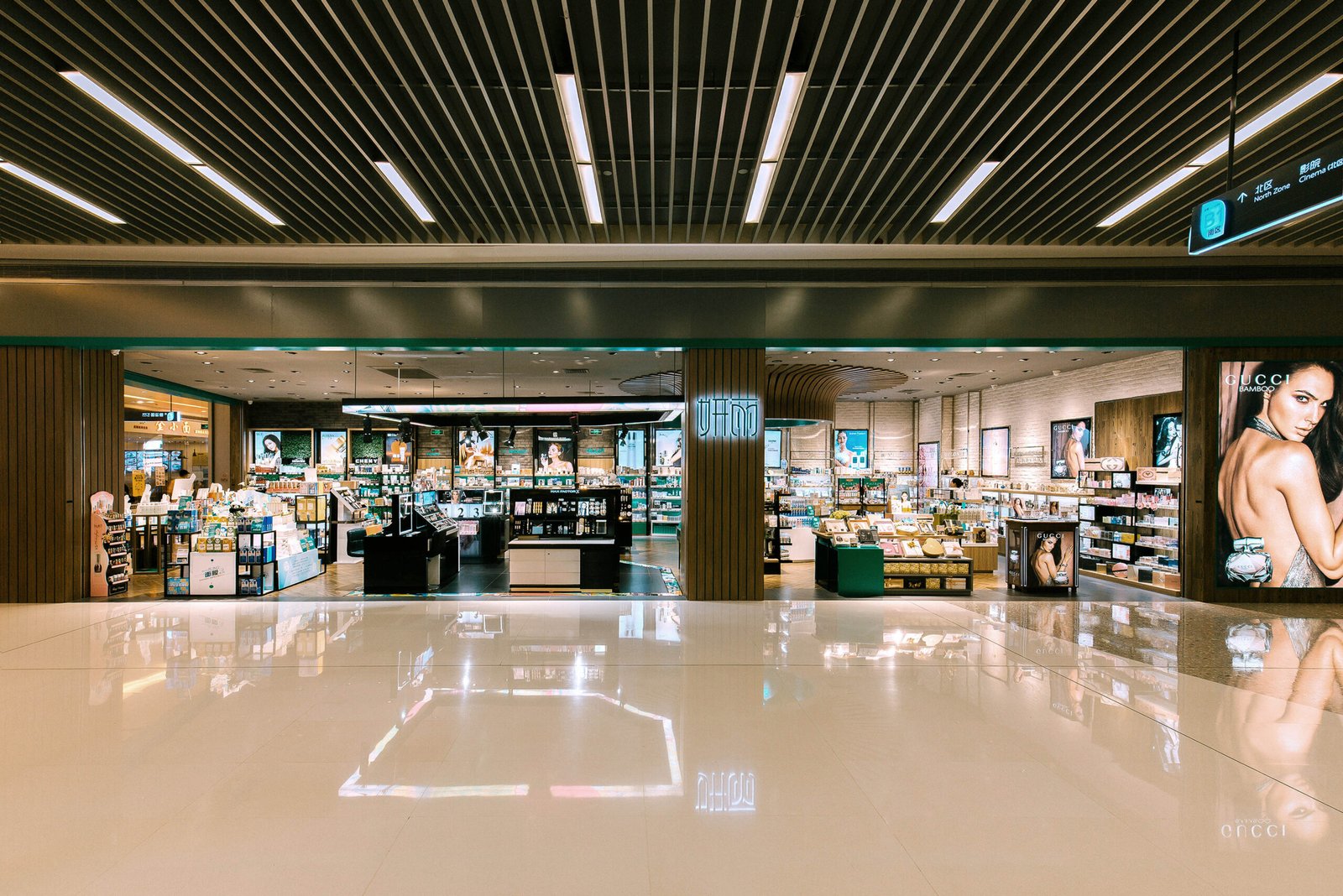
Selecting an LED linear light for a commercial project often turns into a frustrating numbers game when fixtures with identical datasheets look completely different on-site. Choosing the wrong optical metrics leads to inadequate work surface illumination, visual fatigue, or unnecessary energy costs. Understanding how core specifications interact helps you procure lighting that delivers predictable performance on every job.
An LED linear light cannot be judged by individual metrics in isolation. Wattage measures electrical power consumption, while lumens measure total light output. Color Rendering Index (CRI) determines color fidelity on target surfaces, and Unified Glare Rating (UGR) predicts visual comfort within a specific space layout.1 Successful specification requires balancing all four parameters against the architectural environment.
Many overseas contractors and importers discover that relying strictly on catalog figures leads to expensive rework. Let us explore the mechanics behind these four essential parameters from a factory floor perspective so you can evaluate technical datasheets with confidence.
Why Is Wattage Alone Misleading When Evaluating an LED Linear Light?
Buyers often assume higher wattage automatically guarantees a brighter space, but wattage measures only power draw. Relying solely on power ratings leads to energy waste or surprisingly dim interiors. Evaluating luminous efficacy and fixture length alongside wattage solves this common procurement mismatch.
Wattage indicates only the electrical energy an LED linear light consumes, not how much usable light reaches the target surface. Fixture efficacy (lumens per watt), driver efficiency, optical lens transmission, and aluminum thermal dissipation determine actual output. Two fixtures with identical 40W ratings can produce vastly different brightness levels.2
The Relationship Between Wattage and Efficacy
In our assembly and testing workshop, I frequently see fixtures configured to consume identical input power while generating completely different usable light. Wattage ($W$) tells your electrical engineer how much load to plan for the circuit breaker. It tells you nothing about optical brightness. Luminous efficacy—expressed as lumens per watt ($lm/W$)—bridges that gap.
A standard continuous-run fixture operating at 130 lm/W delivers significantly more light than an older design operating at 90 lm/W at the exact same wattage. When buyers demand a higher wattage fixture without considering efficacy, they often end up paying higher utility bills while generating excess thermal load inside the extruded aluminum profile.
Total Lumens = Input Wattage (W) × Fixture System Efficacy (lm/W)System efficacy accounts for optical losses from diffusers and electrical losses across the constant-current LED driver. If an engineer rates the bare LED strip at 160 lm/W, the completed luminaire may only deliver 115 lm/W once the light passes through a milky polycarbonate diffuser.3
Thermal Dissipation and Driver Loading
Power consumption directly impacts thermal performance. When an aluminum housing cannot dissipate the heat generated by an overdriven board, internal junction temperatures rise. Elevated junction temperatures degrade luminous output rapidly and shorten fixture lifespan.4
| Driver Current Setting | Fixture Length | System Wattage | Typical Efficacy | Total Output | Thermal Stress Level |
|---|---|---|---|---|---|
| 350 mA (Conservative) | 1200 mm | 28 W | 135 lm/W | 3,780 lm | Low |
| 500 mA (Balanced) | 1200 mm | 40 W | 120 lm/W | 4,800 lm | Moderate |
| 700 mA (High-Output) | 1200 mm | 56 W | 105 lm/W | 5,880 lm | High (Requires verified heatsink) |
During aging rack testing, we monitor how thermal stabilization affects actual wattage draw. As thermal equilibrium is reached over a 4-hour to 8-hour burn-in period, an improperly cooled luminaire can lose 5% to 12% of its initial lumen output. Always evaluate wattage as a component of thermal design rather than an index of brightness.
How Do Lumens Translate to Real-World LED Linear Light Performance?
Procuring an LED linear light based purely on gross lumen output often yields disappointing surface illumination. When light scatters across ceiling plenums instead of focusing on desks, projects fail compliance checks. Evaluating light distribution curves alongside raw lumens ensures light lands exactly where tasks occur.
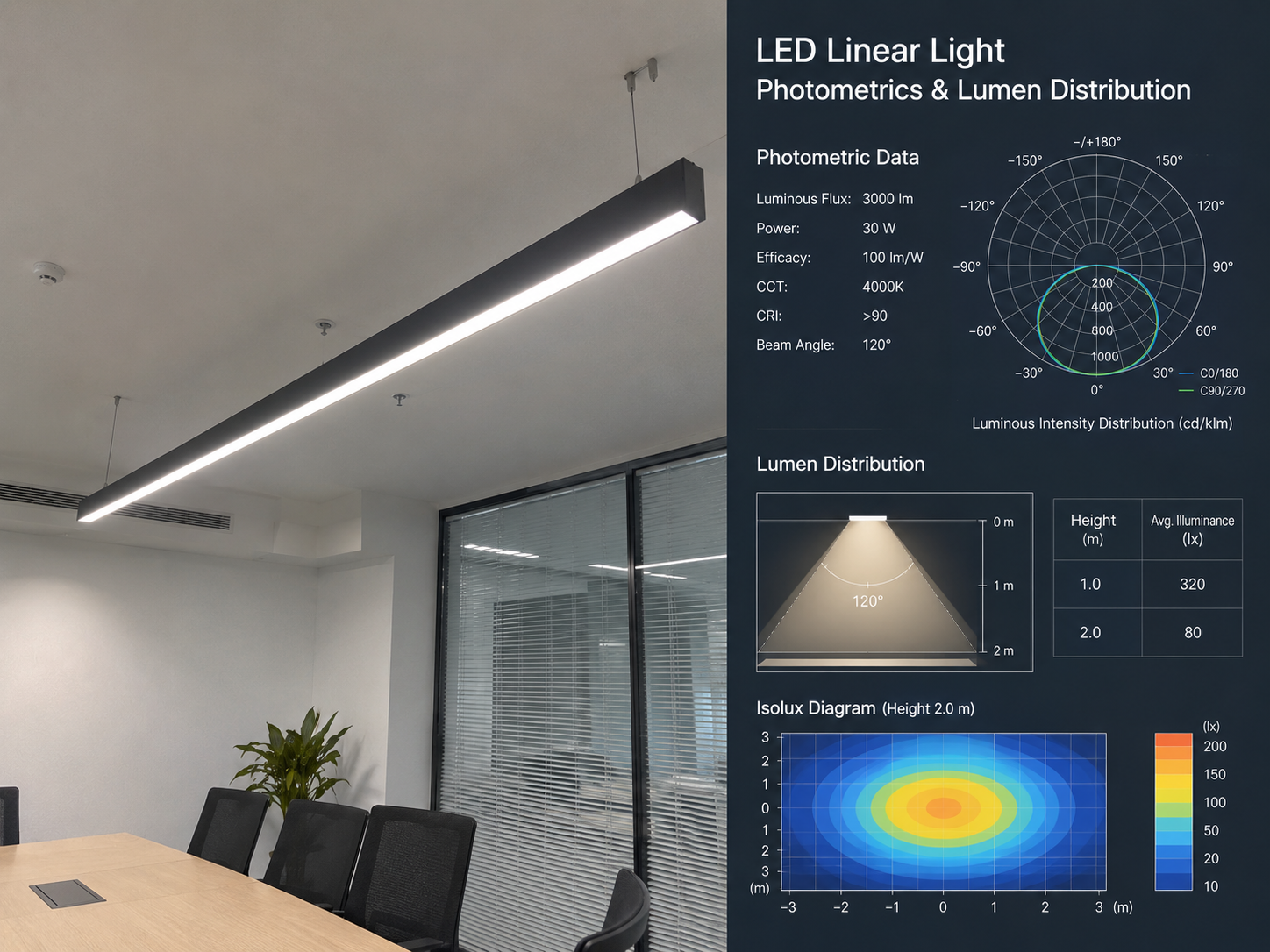
Raw lumen ratings measure total spherical light output at the emitter source, not usable illumination on task surfaces. Mounting height, optical beam angle, diffuser transmittance, room surface reflectance, and suspension depth dictate final lux levels. Identical lumen packages produce drastically different lux readings when paired with prismatic lenses versus frosted diffusers.
Source Lumens vs. Fixture Lumens
One common mistake on supplier submittal sheets is confusing source lumens with fixture lumens:
- Source Lumens: The raw theoretical output generated by the bare SMD LED packages on the PCB, measured in laboratory conditions without secondary optics.
- Fixture (Delivered) Lumens: The actual light emerging from the luminaire after optical absorption, masking from internal clips, and diffuser scattering.
In custom manufacturing, optical diffusers cause noticeable attenuation. An opal diffuse cover absorbs between 20% and 35% of bare LED lumens to create a seamless, spot-free line of light. In contrast, a clear microprismatic lens absorbs only 10% to 15%, directing light downward toward the visual task.5
Delivered Lux on the Workplane
Lumens describe the total volume of light emitted. Lux ($lx$), or lumens per square meter, defines how bright the target surface actually is. Space geometry dictates this transition.
- Mounting Height: Illuminance follows the inverse-square law for point sources and a near-linear falloff for continuous linear runs. Suspending an extrusion 1 meter closer to an office desk doubles the illuminance on that desk without altering lumen output.6
- Beam Spread: A wide 110° diffuse beam spreads lumens across perimeter walls and ceilings. A controlled 60° or 75° optical beam concentrates those lumens into a tighter zone, yielding higher task lux from fewer total lumens.
- Room Cavity Ratios (RCR): Dark carpets, glass walls, and open ceilings absorb unguided lumens. Light-colored concrete and high-reflectance acoustic tiles bounce ambient light back down.
When reviewing photometric IES or LDT files, verify the downward light output ratio (DLOR). Fixtures engineered for direct/indirect illumination split their lumen package—for example, 70% downward to the desk and 30% upward to balance ceiling contrast. Knowing where lumens travel is far more valuable than simply knowing how many lumens exit the driver.
How Should You Select CRI for Commercial LED Linear Lighting?
Specifying the highest possible Color Rendering Index (CRI) seems like a safe choice, but it can needlessly inflate fixture costs and lower system efficacy. Overlooking specific visual tasks leads to washed-out merchandise or compromised energy targets. Matching CRI to the project function ensures both visual quality and operating efficiency.
CRI measures how accurately a light source reveals object colors compared to natural daylight on an Ra scale of 0 to 100.7 Commercial spaces do not all require Ra90+ or Ra97. General office circulation functions well at Ra80, while premium retail, hospitality, and galleries demand Ra90+ with strong R9 saturated red performance.
The Trade-Off Between CRI and Luminous Efficacy
Color rendering involves a physical trade-off on the LED emitter tape. Phosphor compositions that convert blue pump LED light into broader spectrum wavelengths—especially deep reds and cyans—absorb more excitation energy.
- CRI Ra 80: Utilizes standard yellow/green phosphors. Delivers high efficacy (typically 130–150 lm/W at module level) with acceptable general clarity.
- CRI Ra 90: Requires additional red fluoride or nitride phosphors. Reduces baseline module efficacy by roughly 10% to 18% compared to Ra80 chips.8
- CRI Ra 95+ (Full Spectrum): Emulates natural sunlight closely. Results in an efficacy penalty of 20% to 25%, demanding higher driver currents or longer profile footprints to achieve equivalent illuminance.
When clients specify Ra90 throughout an entire corporate warehouse or back-of-house corridor, operational energy consumption climbs without delivering practical visual benefits.
The Role of R9 in Saturated Colors
Standard CRI ($R_a$) is the average of color test samples R1 through R8, which are primarily pastel tones. It completely ignores $R_9$, the metric for saturated deep red.
Ra = (R1 + R2 + R3 + R4 + R5 + R6 + R7 + R8) ÷ 8A fixture can display an advertised $R_a$ of 82 while its $R_9$ score remains below zero. In spaces like apparel stores, grocery display zones, art galleries, and hotel lounges, weak $R_9$ values leave wood finishes, fabrics, and skin tones looking pale and lifeless.
┌─────────────────────────────────────────────────────────────────┐
│               RECOMMENDED CRI RANGES BY TASK                    │
├───────────────────────────────┬─────────────────────────────────┤
│ Application Space             │ Target CRI / Metrics            │
├───────────────────────────────┼─────────────────────────────────┤
│ Warehouses & Utility Rooms    │ Ra 70 – 80 (R9 non-critical)    │
│ Open Offices & Classrooms     │ Ra 80 – 85 (R9 > 0)             │
│ Healthcare Examination        │ Ra 90+ (R9 > 50, Cyan R12 high) │
│ Premium Retail & Cosmetics    │ Ra 90 – 95+ (R9 > 50 to 80)     │
│ Hospitality & Dining Lounges  │ Ra 90+ (with warm 2700K–3000K)  │
└───────────────────────────────┴─────────────────────────────────┘
During pre-production checks, we test LED sub-batches with our integrating sphere to verify both $R_a$ and $R_9$ values against the approved submittal sheet. Buyers should always ask for verified spectral power distribution (SPD) reports when color fidelity directly impacts retail sales or interior finishes.
Why Is UGR Not a Fixed Metric for an LED Linear Light?
Lighting datasheets frequently claim an LED linear light has a "UGR < 19" rating, leading buyers to believe glare is permanently resolved. In reality, improper installation still causes severe screen reflections and eye fatigue. Treating UGR as an environmental calculation rather than a luminaire stamp protects project integrity.
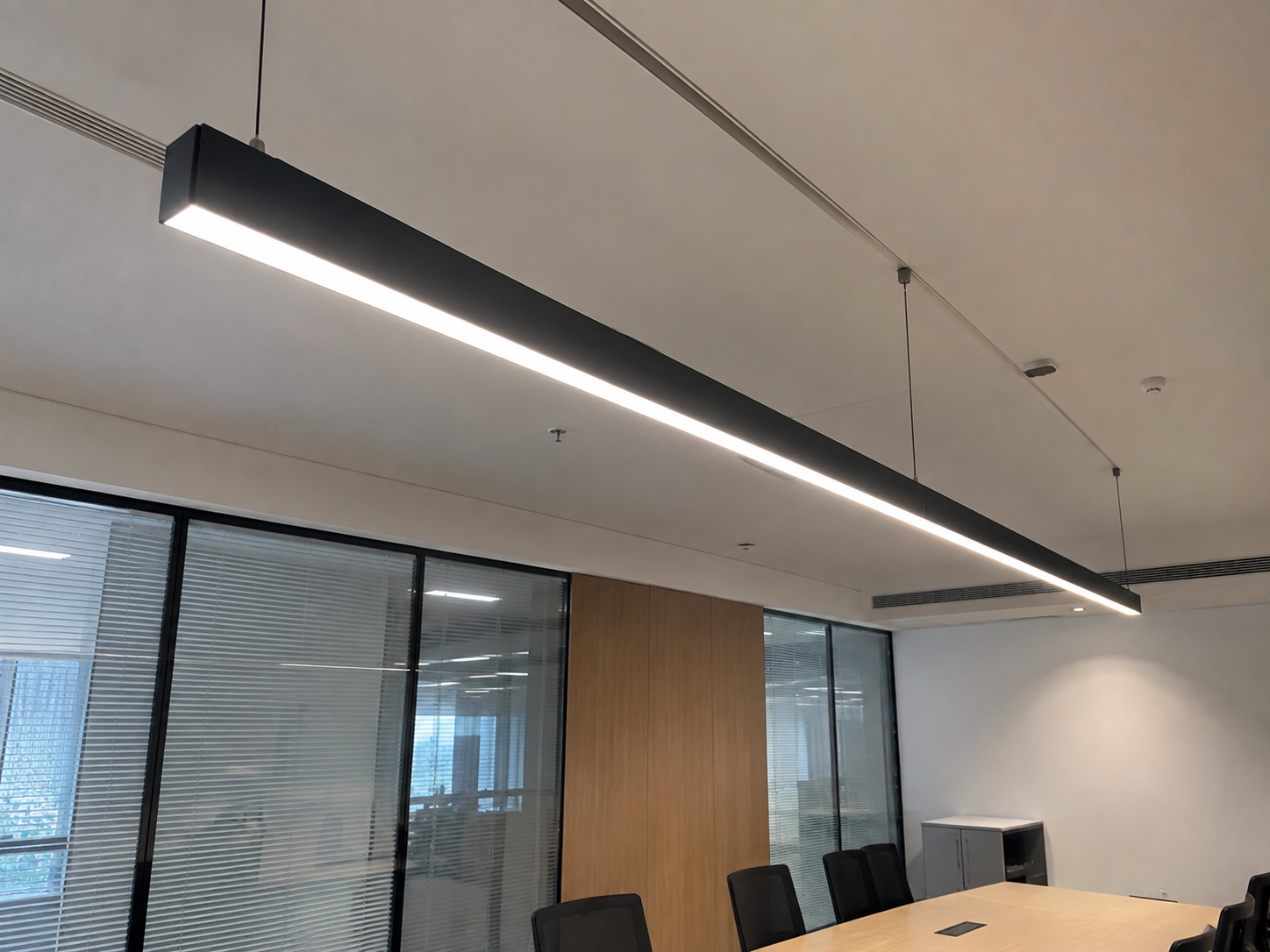
Unified Glare Rating (UGR) is a mathematical calculation of perceived glare within a specific interior room geometry, not an intrinsic fixture property.9 A fixture only achieves UGR < 19 when evaluated under defined standardized room dimensions, background reflectance values, mounting heights, observer positions, and specific microprismatic or louver optical shielding.
How UGR Is Derived
The international standard formula for Unified Glare Rating balances luminaire luminance against background luminance across an observer's line of sight:
$$UGR = 8 log left[ frac{0.25}{L_b} sum left( frac{L^2 cdot omega}{p^2} right) right]$$
Where:
- $L_b$ = Background luminance ($cd/m^2$)
- $L$ = Luminance of the luminous parts of each luminaire in the direction of the observer's eye
- $omega$ = Solid angle of the luminous parts of the luminaire at the observer's eye
- $p$ = Guth displacement index (position relative to line of sight)
Because background luminance ($L_b$) appears in the denominator, the exact same luminaire installed in a room with black matte ceilings will yield a much higher, harsher glare rating than when suspended beneath a white reflective ceiling.10
Diffuser Engineering for Glare Suppression
A bare strip light with an opal PMMA diffuser cannot achieve low glare at high lumen outputs. The broad luminance of an unshielded milky cover spreads light directly into normal peripheral viewing angles (between 45° and 85° from the vertical axis).
To control glare in office workstations conforming to EN 12464-1 standards, we modify the optical stack:
- Microprismatic Diffusers (UGR < 19 oriented): The textured side features miniature pyramidal or hexagonal prisms that redirect lateral rays downward toward 0°–60°, cutting off high-angle rays that strike the eye directly.
- Dark-Light Louvers / Baffles: Recessed black or specular louvers isolate individual LED clusters, cutting off crosswise and endwise glare almost completely.
- Asymmetric and Batwing Reflectors: Distribute light outward to the sides while maintaining a lower luminance directly below the fixture.
Never accept a blanket "UGR < 19 compliant" statement from a supplier without requesting their standard reference table (the CIE tabular method using a $4H/8H$ room with $70/50/20$ surface reflectances). Professional contractors should model the luminaire IES file in simulation software like DIALux or Relux using actual job site dimensions.
How Can Buyers Verify LED Linear Light Specifications Before Mass Production?
Importing architectural fixtures based solely on catalog promises creates major financial and operational exposure for overseas distributors. Discovering mismatched color consistency or driver failure on-site destroys client trust. Establishing a rigorous sample verification and factory testing workflow prevents costly post-installation failures before bulk shipments leave the factory.
Buyers should verify an LED linear light through physical sample benchmarking, integrating sphere photometric reports, driver thermal monitoring, and full aging tests. Requesting pre-shipment inspection videos, checking aluminum profile heat dissipation under sustained loads, and confirming optical lens fitment ensures the production batch matches approved submittal standards.
Factory QC and Sample Verification Checklist
When sourcing customized extrusion systems, evaluate sample units with a disciplined checklist before releasing production deposits.
- [ ] Housing Wall Thickness: Check the aluminum profile with calipers. Thin walls (< 1.1 mm on wide bodies) flex during installation and fail to conduct heat away from the PCB.
- [ ] Optical Seal and Light Leakage: Inspect fixture end caps and corner joiners. Poorly fitted injection-molded caps allow distracting light pinholes at continuous-run intersections.
- [ ] MacAdam Ellipse (SDCM): Confirm whether LEDs maintain a 3-step or 5-step MacAdam ellipse. Variations across a 20-meter continuous line create visible color banding.11
- [ ] Driver Certification and Ripple: Verify driver test certificates (such as CE, CB, or ENEC). Ensure ripple current is under 5% to eliminate invisible camera flicker in office spaces.
Production and Aging Protocols
At our facility, every linear run undergoes continuous aging testing under electrical load. We test the complete assembly—housing, driver, custom wire harnesses, and optics—together.
Step 1: Incoming Inspection (IQC)
├── Aluminum extrusion tolerance & finish check
├── LED board batch test (CCT, CRI, forward voltage)
└── Constant-current driver batch screening
        │
Step 2: Sub-Assembly & Wiring
├── High-conductivity thermal interface placement
└── Mechanical fastening of PCB to aluminum chassis
        │
Step 3: Continuous Burn-In Aging
├── 100% of finished linear fixtures powered on
├── High-voltage / low-voltage cycling stress tests
└── Minimum 4 to 12-hour continuous thermal soak
        │
Step 4: Final Inspection & Video Confirmation
├── CCT/Lumen spot check on spectrometer
├── Optical alignment & lens continuity check
└── Pre-shipment video verification for overseas buyers
Requesting clear video documentation of your batch on the aging rack provides verifiable assurance that the products ready for packing match the approved engineering sample.
Frequently Asked Questions
Can an LED linear light achieve UGR < 19 with a standard frosted diffuser?
Rarely in typical office ceiling heights. Standard frosted diffusers scatter light uniformly in all directions, creating high surface luminance above a 65° viewing angle. Achieving true UGR < 19 usually requires microprismatic optics, recessed internal louvers, or deep architectural baffles.
What is the ideal luminous efficacy for an indoor LED linear light?
A well-engineered commercial fixture typically delivers between 110 and 140 lm/W at the system level. Fixtures with high-CRI requirements (Ra95+) or heavy anti-glare louvers may operate closer to 90–105 lm/W due to optical absorption and broader phosphor conversion.
Does a higher CRI reduce the lumen output of a linear fixture?
Yes. Moving from CRI Ra80 to Ra90 typically reduces total lumen output by 10% to 18% under identical power settings. This happens because the red phosphors needed to improve color rendering absorb more blue photons from the LED pump chip.
How do I verify the photometric performance of a custom-length linear light?
Ask the manufacturer for an IES or LDT file measured via a calibrated goniophotometer for that specific optical family. For non-standard lengths, qualified suppliers scale photometric data proportionally while verifying electrical parameters through integrating sphere tests on physical samples.
Conclusion
Wattage, lumens, CRI, and UGR are interdependent variables that must be harmonized against specific space dimensions, mounting heights, and visual tasks. Looking at any single specification on a datasheet without considering the overall optical and thermal design invites unexpected failures on-site.
Before committing to large commercial orders, always evaluate physical samples, inspect thermal dissipation qualities, and request full photometric data. If your upcoming architectural project requires tailored configurations, our team at Shenzhen Justar provides custom aluminum tooling, flexible parameter adjustments, and strict aging verification on every LED linear light batch. Contact our engineering team today to review your project specifications and schedule sample evaluations.
"Color rendering index", https://en.wikipedia.org/wiki/Color_rendering_index. Authoritative lighting references define wattage as electrical power, lumens as luminous flux, CRI as a color-rendering metric, and UGR as a glare calculation; however, UGR is context-dependent and not an intrinsic luminaire property. Evidence role: definition; source type: encyclopedia. Supports: Standard definitions of wattage, luminous flux, color rendering index, and unified glare rating.. Scope note: Terminology and metric versions differ slightly between CIE, IES, and regional standards. ↩
"LED Lighting Efficacy: Status and Directions", https://www.osti.gov/servlets/purl/1421610. LED lighting research and standards show that luminous flux depends on LED package efficiency, driver efficiency, thermal conditions, and optical transmission, so identical wattage does not guarantee equal brightness. Evidence role: mechanism; source type: research. Supports: Wattage is an input-power metric, while delivered light depends on efficacy and optical losses.. Scope note: The 40 W example is illustrative and not a specific experimental comparison. ↩
"LED Lighting Efficacy: Status and Directions", https://www.osti.gov/servlets/purl/1421610. Studies of LED luminaire optics report that diffusers and secondary optics attenuate luminous flux, and driver losses further reduce system efficacy compared with bare LED strip measurements. Evidence role: mechanism; source type: paper. Supports: Optical diffusers and driver losses reduce delivered luminaire efficacy relative to bare LED measurements.. Scope note: The 160 to 115 lm/W example depends on specific materials, thickness, and driver design and is not a universal conversion. ↩
"A Critical Review on the Junction Temperature Measurement ...", https://pmc.ncbi.nlm.nih.gov/articles/PMC9611508/. LED reliability literature consistently associates elevated junction temperatures with accelerated lumen depreciation and reduced useful life, particularly when heat sinking is inadequate. Evidence role: mechanism; source type: research. Supports: Junction temperature is a key driver of LED lumen depreciation and useful life.. Scope note: Degradation rates depend on LED type, drive current, and thermal design. ↩
"Luminescent light diffuser for diffuse lighting applications - PMC", https://pmc.ncbi.nlm.nih.gov/articles/PMC10108133/. Optical studies of LED diffusers commonly report transmittance losses in overlapping ranges; opal materials generally absorb more light than clear microprismatic films, though exact values depend on material and thickness. Evidence role: statistic; source type: paper. Supports: Diffuser type influences optical transmittance, with opal covers generally causing greater loss than clear microprismatic optics.. Scope note: The specific 20–35% and 10–15% ranges are indicative and may vary by product. ↩
"Inverse Square Law for Light", http://hyperphysics.phy-astr.gsu.edu/hbase/vision/isql.html. Photometry textbooks state that point-source illuminance varies inversely with the square of distance, while extended linear sources exhibit a different spatial falloff; reducing mounting height can therefore raise workplane illuminance without changing luminous flux. Evidence role: mechanism; source type: education. Supports: Photometric principles relate illuminance to source distance and geometry, so mounting height affects workplane illuminance.. Scope note: The claim that a 1 m reduction doubles illuminance is an approximation depending on source geometry, room reflections, and measurement position. ↩
"Color rendering index", https://en.wikipedia.org/wiki/Color_rendering_index. The Color Rendering Index is defined by CIE as a measure of how a light source renders colors relative to a reference illuminant, conventionally reported on a 0–100 Ra scale. Evidence role: definition; source type: encyclopedia. Supports: CRI is a standardized metric for color rendering compared with a reference illuminant.. Scope note: CRI has known limitations for saturated colors, which is why supplementary metrics such as R9 are used. ↩
"From physics to fixtures to food: current and potential LED ...", https://pmc.ncbi.nlm.nih.gov/articles/PMC7105460/. LED phosphor research documents that broadening the emission spectrum for higher CRI can reduce efficacy relative to lower-CRI versions, with reported penalties often in the range of approximately 10–20% depending on the phosphor system. Evidence role: statistic; source type: research. Supports: Higher-CRI LED spectra often incur an efficacy penalty due to broader phosphor emission.. Scope note: The exact penalty varies by LED platform, drive current, and thermal conditions and is not a fixed rule. ↩
"Calculation and Presentation of the Standard CIE UGR ...", https://www.academia.edu/9504476/Calculation_and_Presentation_of_the_Standard_CIE_UGR_Table_for_Indoor_Lighting_Luminaires. CIE defines UGR as a tabular calculation that incorporates room dimensions, surface reflectances, luminaire luminance, and observer position; it is therefore not a standalone property of a luminaire. Evidence role: definition; source type: institution. Supports: UGR is defined as a room- and layout-dependent glare calculation.. Scope note: UGR values are only comparable when the same standardized calculation assumptions are used. ↩
"Understanding UGR (Unified Glare Rating)", https://www.innerscene.com/SpecHelp/CircadianSky/ugr. UGR calculations include background luminance, which is influenced by room surface reflectances; lower-reflectance surfaces such as black ceilings reduce background luminance and can increase the calculated UGR for the same luminaire. Evidence role: mechanism; source type: institution. Supports: Background luminance in the UGR formula depends on room surface reflectances, so dark surfaces can increase calculated glare.. Scope note: The magnitude of the effect depends on room geometry, luminaire distribution, and viewing conditions. ↩
"Color Stability of LEDs: Understanding the Basics", https://www1.eere.energy.gov/buildings/publications/pdfs/ssl/royer_stability_lightfair2014.pdf. LED color-binning standards use MacAdam ellipses to quantify chromaticity variation; tighter bins such as 3-step generally reduce visible color differences in continuous linear installations compared with wider bins. Evidence role: mechanism; source type: research. Supports: MacAdam ellipse binning quantifies LED chromaticity variation, which can affect visual color uniformity in installations.. Scope note: Visibility of banding depends on viewing distance, observer sensitivity, spacing, and ambient conditions, so a 20-meter example is contextual. ↩