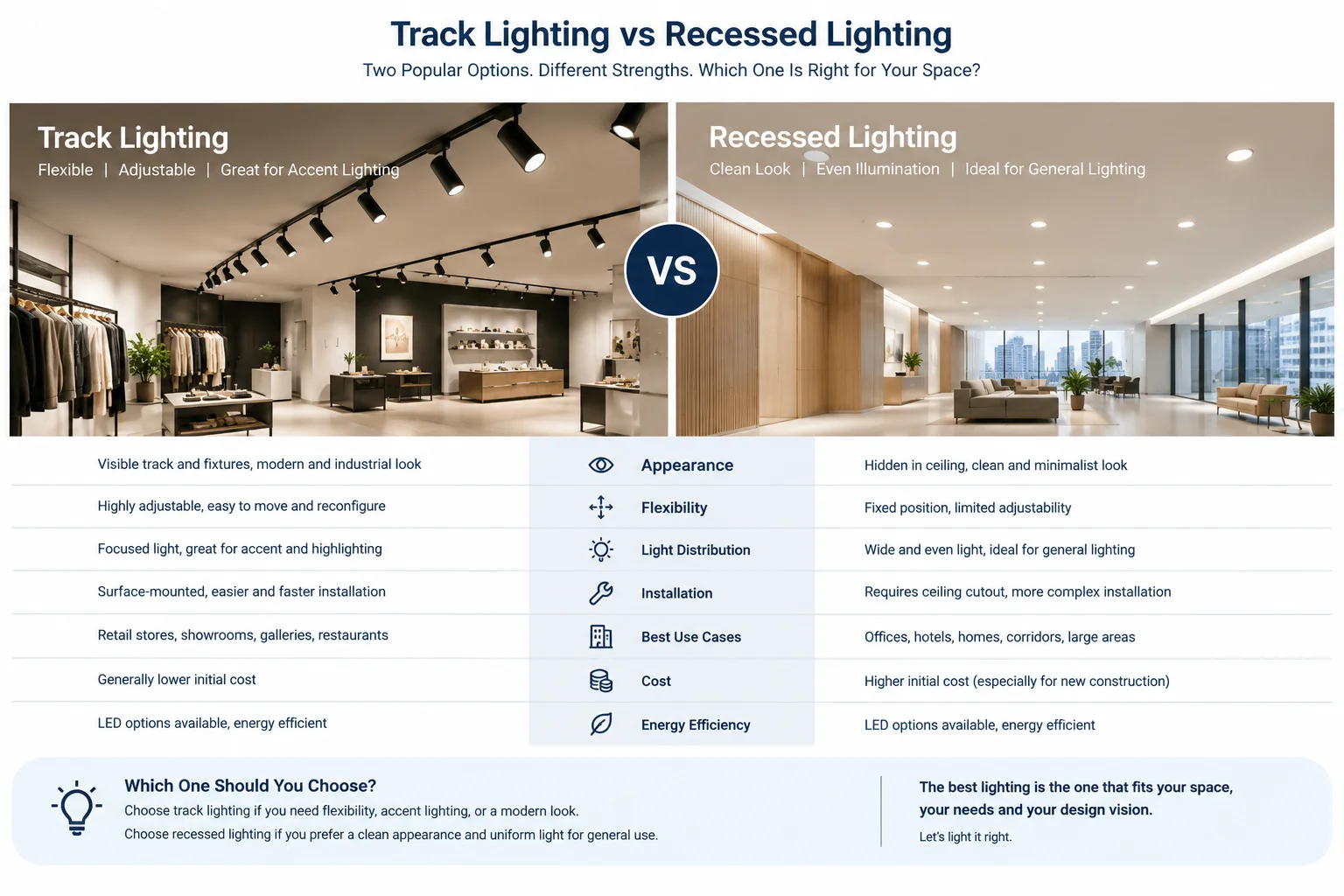
Choosing between track lighting vs recessed lighting often creates costly dilemmas for commercial contractors, retail managers, and project procurement teams. Specifying the wrong luminaire can lead to messy ceiling rework, inadequate illuminance on merchandise, or inflexible layouts that compromise your client's design intent. You can avoid these expensive mistakes by matching each fixture's optical characteristics and mounting hardware to your specific ceiling architecture and functional illumination tasks.
When evaluating track lighting vs recessed lighting, your choice depends on your ceiling structure, installation constraints, and lighting tasks. Recessed downlights install flush into false ceilings to provide clean, glare-controlled ambient light. Track lights mount directly to tracks on finished ceilings to deliver rotatable, adjustable directional illumination for changing displays and architectural focal points.
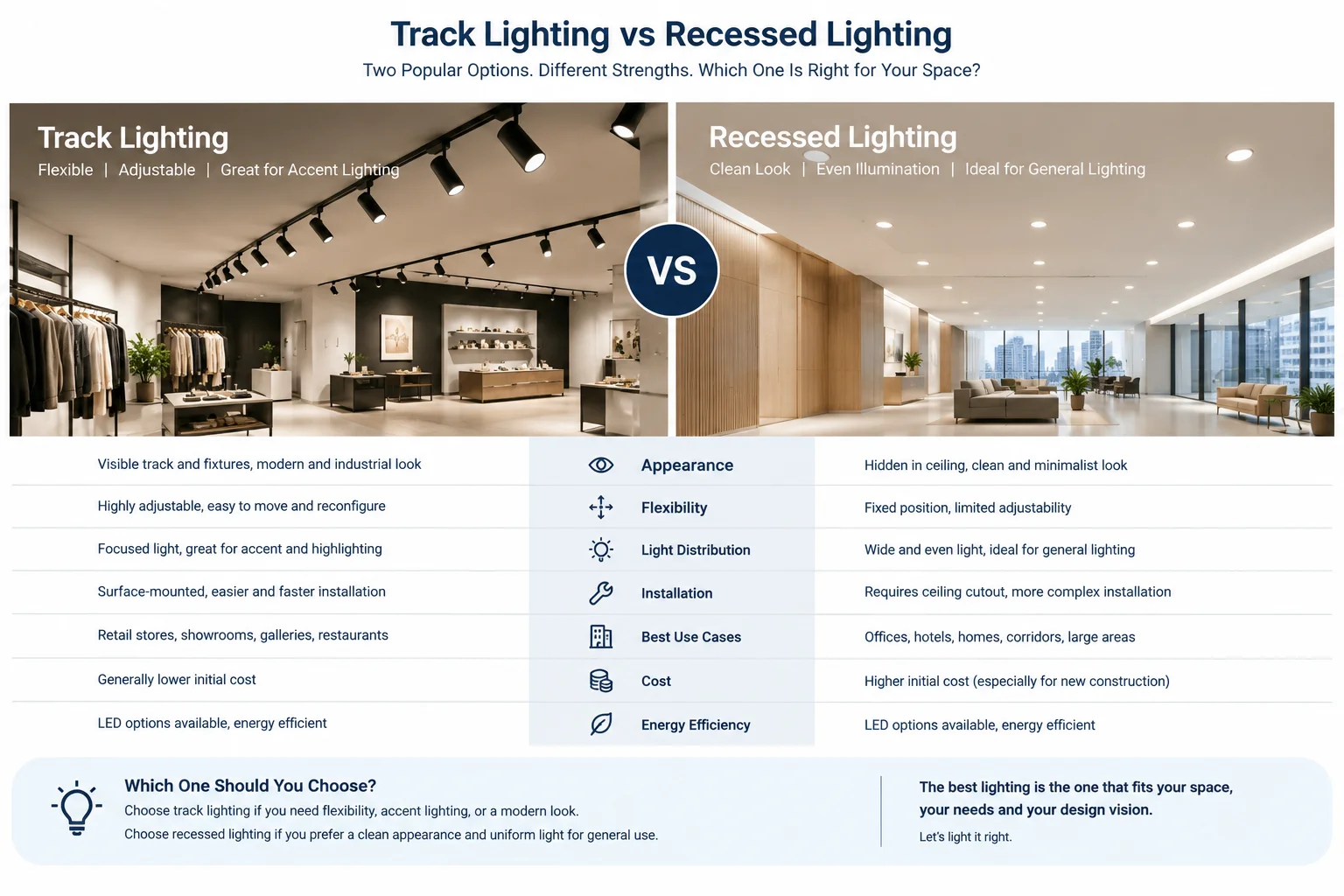
Every commercial environment presents different spatial limitations and optical demands. A retail boutique requires different visual hierarchy than an open-plan corporate office. Let us examine the structural, technical, and operational differences between these two workhorse lighting systems so you can specify fixtures with total confidence.
How Do Ceiling Conditions Dictate Track Lighting vs Recessed Lighting?
Specifying recessed fixtures for a building without suspended ceilings creates an immediate budget disaster. When electrical contractors discover solid concrete slabs or shallow plenum depths on site, work stops and redesign costs skyrocket. You can eliminate installation friction by evaluating the physical boundaries of your ceiling before issuing purchase orders.
In the track lighting vs recessed lighting debate, ceiling construction is the primary physical filter. Recessed fixtures require sufficient ceiling cavity depth, precise cutouts, and plenum clearance for heat dissipation1. Track systems install onto surface-mounted or suspended rails, making them ideal for concrete ceilings, exposed structures, or spaces where cutting into drywall is impossible.
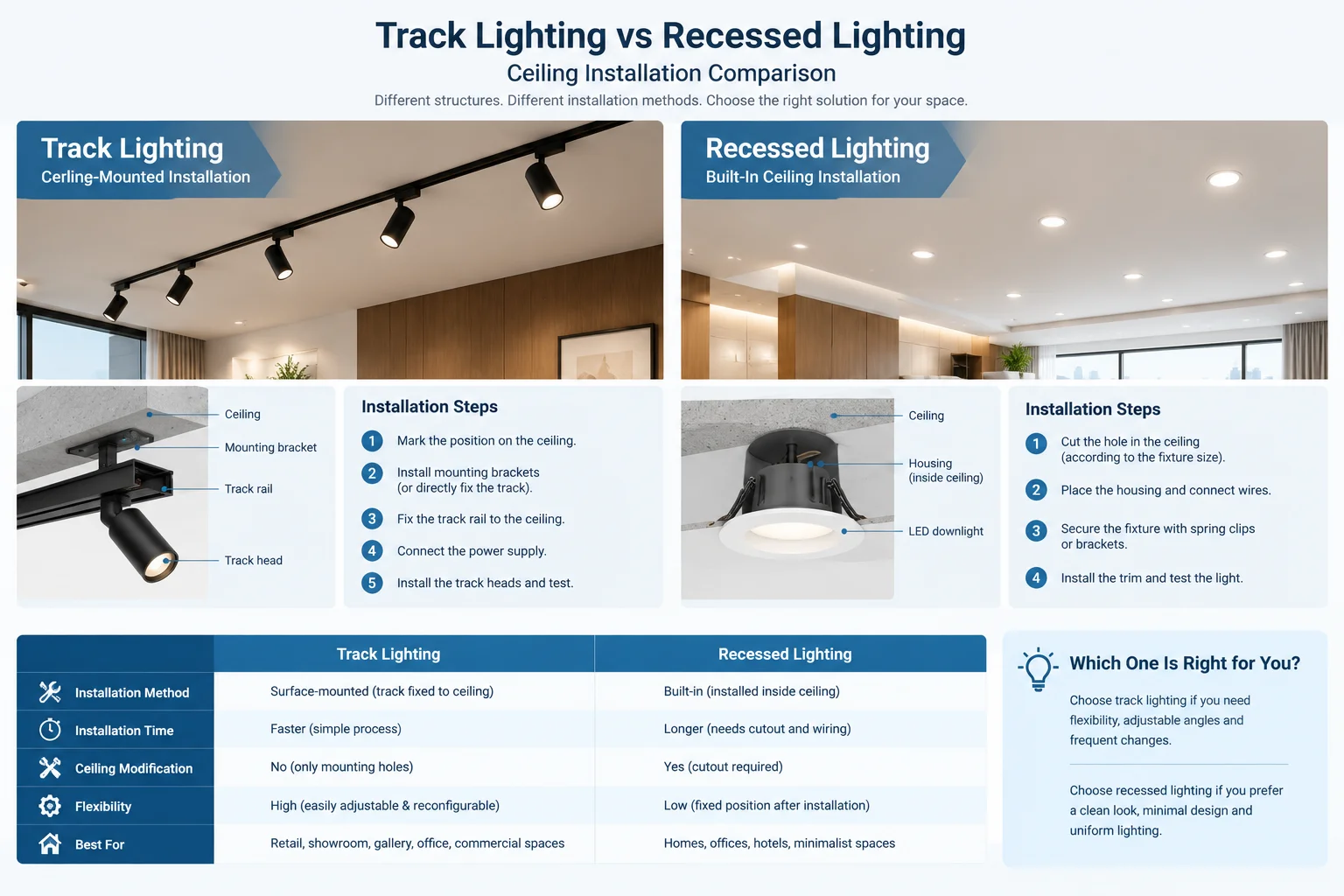
In our manufacturing facility, I frequently consult on project inquiries where buyers send downlight dimensions without confirming plenum clearance. A recessed downlight does not just require room for its optical body. It also requires thermal breathing room for its die-cast aluminum heat sink and external LED driver. If an HVAC duct or structural beam blocks that void, installation is dead on arrival.
Here is a practical breakdown of how common ceiling types handle each system:
| Ceiling Construction Type | Recessed Lighting Feasibility | Track Lighting Feasibility | Primary Procurement Concern |
|---|---|---|---|
| Suspended Plasterboard / Drywall | High | High | Ensure plenum depth matches luminaire height and driver dimensions. |
| Exposed Solid Concrete | Very Low (requires dropped soffit) | High | Track rails mount directly or suspend via aircraft cables; no core drilling needed. |
| Acoustic Drop Tiles (T-Bar Grid) | Moderate to High | Moderate | Reinforce grid clips; check weight ratings for track runs. |
| Open Industrial / Exposed Ductwork | Very Low | High | Suspended tracks bring luminaires down to optimal mounting heights. |
| Historic / Protected Ceilings | Prohibited in most cases | High | Surface or pendant track minimizes permanent structural penetrations. |
When retrofitting an existing interior, cutting dozens of new ceiling apertures for recessed cans produces extensive dust, patching, and repainting. Track lighting utilizes a single power feed junction box to power multiple luminaires along a continuous rail. For projects with restricted construction schedules, surface-mounted or suspended track systems dramatically reduce on-site labor hours.
However, if your architect specifies a continuous, minimalist ceiling plane without visual clutter, recessed luminaires remain the gold standard. You must confirm plenum measurements with the on-site mechanical contractor before finalizing recessed can orders.
How Do Lighting Tasks Separate Recessed Downlights from Track Spotlights?
Lighting a retail showroom entirely with static downlights leaves products looking flat and uninspired. Conversely, flooding an office corridor with high-intensity spotlights creates blinding glare and distracting shadows. You can achieve balanced visual comfort by pairing the optical distribution of each fixture to its intended lighting layer.
Recessed lighting excels at uniform ambient illumination, wall washing, and wide-beam general lighting that seamlessly integrates into architectural surfaces. Track lighting excels at directional accent lighting, focal emphasis, and high-contrast beam shaping where aiming angles must adapt to shifting merchandise, art pieces, or spatial configurations.
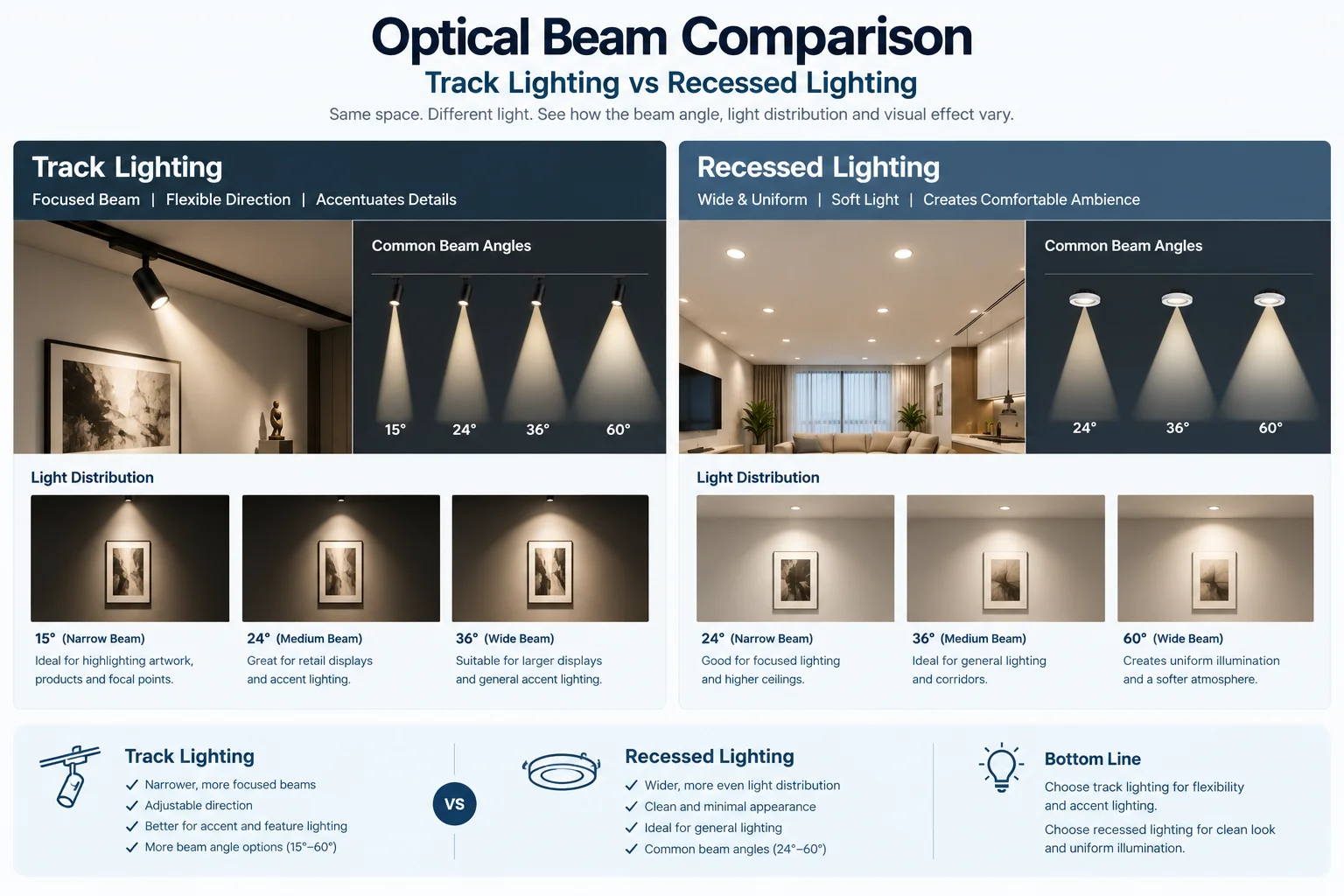
From an engineering and optical testing perspective, the luminaire housing directly dictates beam performance. In our photometric testing darkroom, we test both fixtures on a goniophotometer to verify distribution curves2. Recessed downlights usually feature fixed or slightly gimbaled reflectors designed to push light downward across broad spaces. Track spotlights utilize deep-set secondary optics, such as TIR (total internal reflection) lenses or faceted aluminum reflectors, to concentrate light into narrow, intense beams.
Core Lighting Layers and Fixture Roles
- Ambient / General Lighting: Recessed downlights with beam spreads between 60° and 90°3 disperse light uniformly across horizontal planes, eliminating dark spots across floors and workspaces.
- Accent / Feature Lighting: Track fixtures with narrow beam angles (15° to 36°) provide the high candlepower ratios (typically 3:1 to 5:1 over ambient4) required to make retail displays, mannequins, and artwork visually pop.
- Wall Washing: While specialized asymmetrical recessed wall washers create clean vertical illumination, adjustable track wall washers provide flexible vertical coverage that contractors can retarget if room partitions change.
If your commercial space features seasonal display updates, track lighting provides unmatched operational agility. Store staff can snap a spotlight out of one circuit adapter, insert it elsewhere along the rail, and re-aim the optical head without touching the ceiling wiring. Fixed recessed luminaires cannot match that dynamic flexibility once installed.
Why Does Equal Wattage Not Mean Equal Performance in Track Lighting vs Recessed Lighting?
Procurement managers often assume that a 20-watt recessed light and a 20-watt track light will deliver identical brightness inside a room. This assumption leads to severe under-lighting and disappointing lux levels on the sales floor. You can secure accurate illumination by evaluating delivered lumens, optical efficiency, and beam geometry rather than relying solely on electrical input power.
In comparing track lighting vs recessed lighting, wattage simply indicates power consumption, not usable light on target surfaces. Optical chamber design, lens losses, reflector depth, and beam concentration cause two 20-watt fixtures to generate drastically different center-beam candlepower (CBCP) and lux levels at display height.
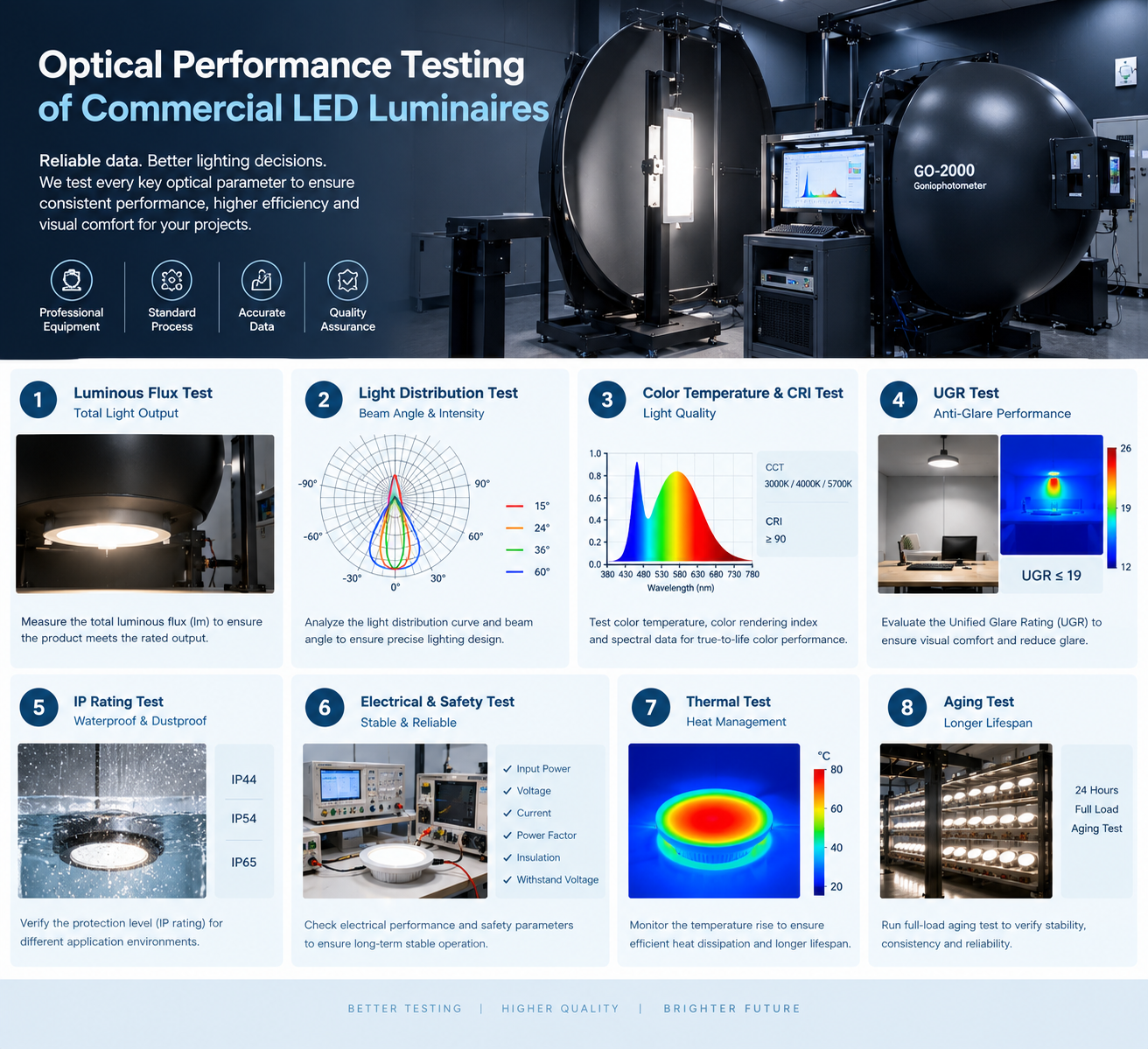
When our engineering team assembles custom LED fixtures, we evaluate every component in the optical train. A 20W track light with a 15° beam angle concentrates its luminous flux onto a compact footprint, producing thousands of lux at the center. Take that exact same 20W LED module, mount it into a deep-baffled recessed downlight with a 75° frosted lens, and the light spreads thinly over a wide area. The peak lux at the center drops substantially.
Consider the technical parameters that directly influence real-world performance:
- Delivered Lumens vs. Chip Lumens: Bare LED package ratings mean little. Luminaire efficiency drops due to optical absorption, trim baffles, and secondary lenses. High-quality track spotlights retain 85% to 90% optical transmission, whereas heavily diffused recessed downlights may lose up to 25% of raw chip output to internal baffle bounce.
- Thermal Management and Lumen Maintenance: Track lights house their heat sinks out in open room air, which facilitates passive convection cooling. Recessed lights operate inside trapped ceiling plenums where ambient temperatures run significantly higher. Inadequate aluminum massing on a recessed downlight causes thermal droop, reducing actual lumen output5 during prolonged operation.
- Color Quality (CRI and SDCM): For commercial retail and hospitality, CRI Ra > 90 and R9 > 506 are vital. A 3000K track light highlighting luxury apparel demands tight color consistency (within a 3-step MacAdam ellipse7) to prevent noticeable tint shifts along adjacent displays.
Always request verified IES or LDT photometric files8 from your factory rather than comparing raw wattage on a product sheet. Running these files through lighting layout software ensures your project achieves required target lux levels.
How Do You Calculate the Real Lifecycle Cost in Track Lighting vs Recessed Lighting?
Focusing exclusively on the initial unit price per fixture creates hidden operational expenses down the road. Cheap recessed housings can require destructive drywall removal during driver failures, while cheap track systems can fail mechanically after minimal repositioning. You can safeguard your project budget by analyzing the complete lifecycle cost, including initial installation, maintenance access, and spatial reconfigurations.
Analyzing lifecycle cost in track lighting vs recessed lighting requires factoring in ceiling preparation, electrician hours, future reconfiguration costs, and component accessibility. Track systems carry slightly higher initial hardware costs but lower installation and remodeling expenses. Recessed installations require lower fixture prices but carry higher initial labor, ceiling cutting, and long-term maintenance overhead.
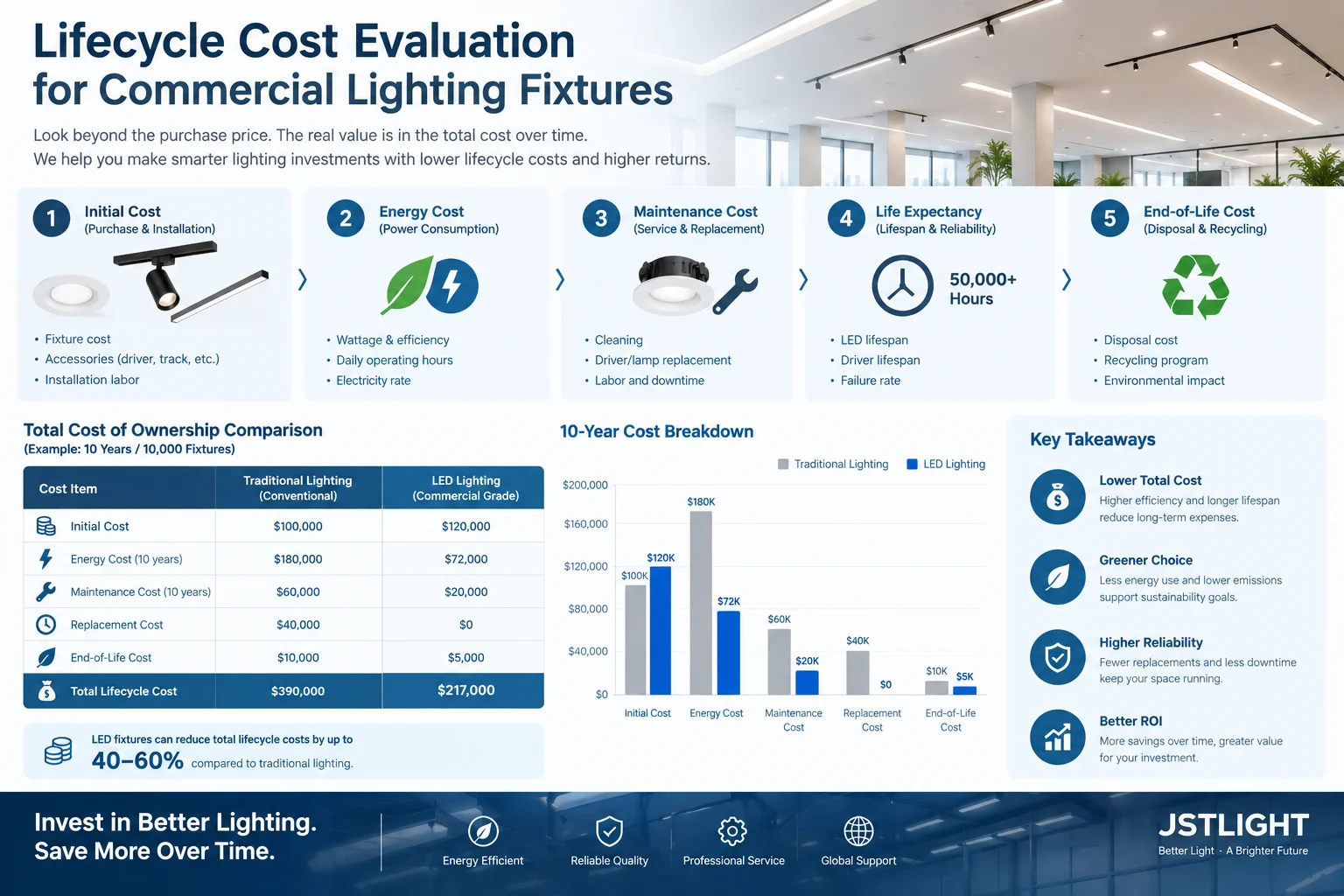
During production and factory testing, we subject luminaire mechanical adapters and terminal blocks to repeated cycling. Track fixtures endure mechanical friction whenever users reposition them. High-grade polycarbonate track adapters with solid copper conductors survive years of store rearrangements. Cheap plastic adapters crack under heat and mechanical stress, arcing on the busbar and demanding premature system replacement.
Evaluate these four cost dimensions during your procurement review:
- Ceiling Framing and Cutting Labor: Recessed lights demand individual holes cut precisely by tradespeople, adding substantial labor hours across large commercial footprints. Track systems require far fewer ceiling mounting points and single-point electrical hookups per run.
- Ease of Component Replacement: LED drivers represent the most common point of failure over a 50,000-hour operational lifespan9. In track systems, the driver is housed inside the track adapter or fixture stem, allowing instantaneous replacement without tools. In recessed fixtures, electricians must reach inside the ceiling cutout to extract the remote driver box, risking ceiling damage.
- Future Reconfiguration Expenses: If an art gallery or retail store moves its walls or display islands, repositioning recessed downlights requires cutting new drywall holes, patching old ones, repainting ceilings, and pulling new wire. With a track system, staff simply slide fixtures along existing rails or clip in additional heads.
- Heat Dissipation and HVAC Load: Efficient thermal conduction through private-mold die-cast aluminum keeps LED junction temperatures low. Properly cooled luminaires experience less lumen depreciation10, extending the years between major capital retrofit investments.
When Should Projects Combine Both Fixture Types for Maximum Impact?
Treating track lighting and recessed downlights as mutually exclusive options limits your project's visual potential. Spaces designed with only one luminaire category frequently end up either visually busy or completely flat. You can achieve an exceptional commercial interior by layering both systems to handle complementary lighting responsibilities.
High-end commercial projects often combine track lighting vs recessed lighting into a cohesive layered plan. Recessed downlights establish comfortable, glare-free ambient base levels across general circulation paths, while track spotlights add contrast, drama, and adjustable directional focus onto architectural surfaces, displays, and reception zones.
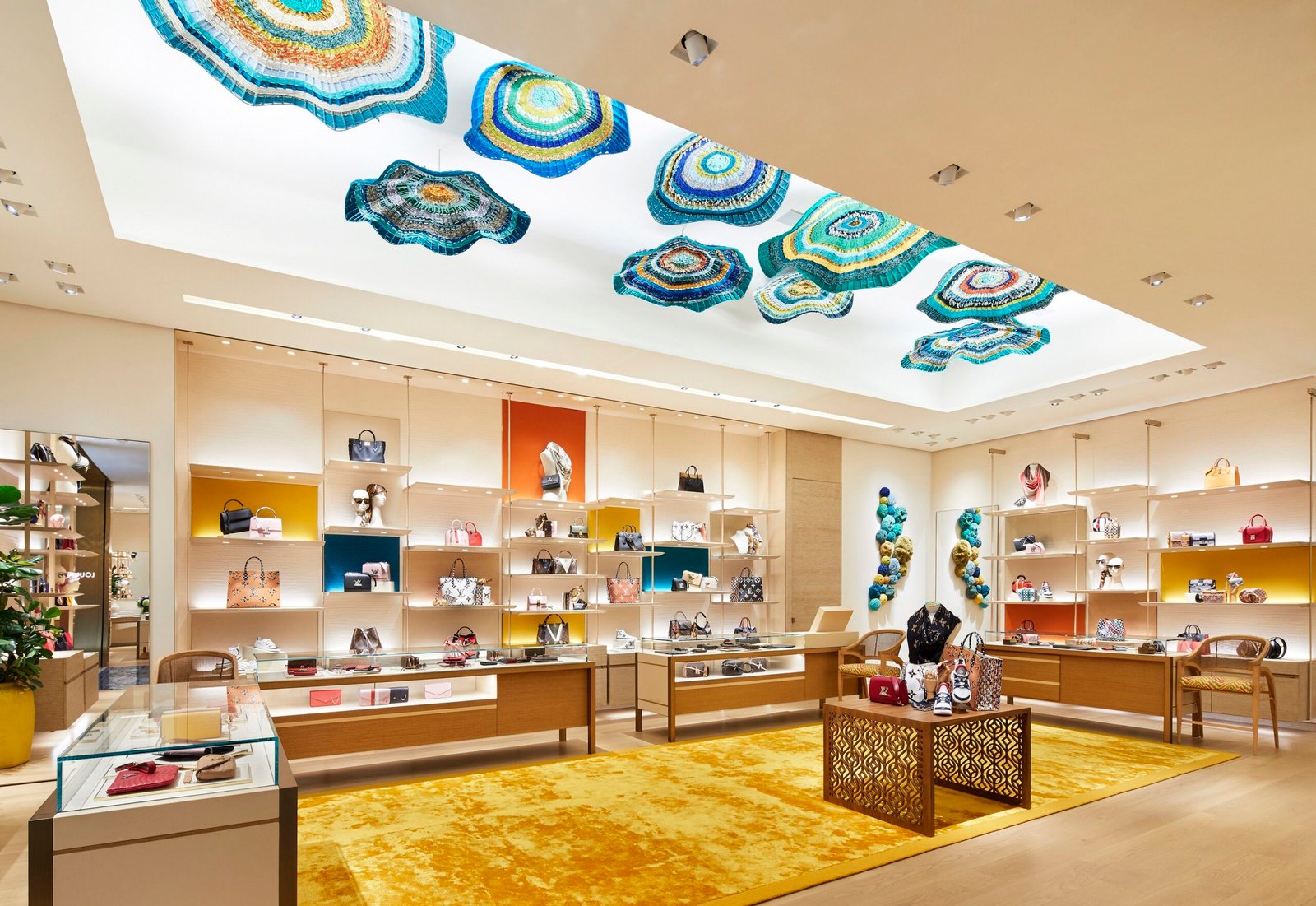
In our manufacturing operations, many of our overseas project orders contain a balanced mix of both luminaire types destined for the exact same job site. A luxury hotel lobby, for example, uses low-glare deep-regressed downlights to illuminate lounge seating without causing reflections on visitor screens. Above the concierge desk and along feature art walls, the designer mounts architectural track systems to deliver dynamic accent beams onto stone textures and company branding.
When pairing these systems across an interior, strict technical synchronization is critical:
- Correlated Color Temperature (CCT) Matching: Specifying 3000K across both systems is not enough. You must ensure both the track lights and downlights use LED chips from the same binning tier (such as 3-step SDCM). A yellowish 3000K downlight next to a pinkish 3000K track light ruins high-end architectural aesthetics.
- Dimming Protocol Harmony: Confirm that your drivers share compatible control protocols across systems. Whether utilizing DALI-2, 0-10V, or phase-cut dimming11, consistent driver response curves prevent lighting banks from dimming unevenly.
- Aesthetic Trim Finishes: Match the powder-coat finishes of your recessed trims to your track rails and spotlight bodies. Standardizing on matching matte white (RAL 9003) or matte black (RAL 9005) ensures architectural harmony across the ceiling plane.
Qualified lighting designers routinely coordinate these layers using simulation software. Combining ambient recessed base light with targeted track highlights yields a flexible, visually captivating interior that serves everyday occupants and high-impact displays alike.
Frequently Asked Questions
Which option is cheaper to install: track lighting or recessed lighting?
Track lighting is generally cheaper to install in retrofit projects or spaces with hard concrete ceilings because it requires only one electrical junction point per track run. Recessed lighting requires individual ceiling apertures, separate wiring connections for every can, and extensive drywall repair if retrofitted into finished ceilings.
Can track lighting provide enough general illumination for a large room?
Yes, track lighting can provide sufficient general ambient illumination if fitted with wide-beam flood attachments, linear track modules, or frosted diffusers. However, relying exclusively on narrow track spotlights for ambient lighting creates harsh shadows, visual clutter on the ceiling, and uncomfortable glare.
How deep must a ceiling cavity be for commercial recessed downlights?
Most commercial recessed downlights require a minimum ceiling cavity depth between 100mm and 150mm (4 to 6 inches)12 to accommodate the optical body, heat sink, and driver. Ultra-thin flat panels require less depth, but high-output architectural downlights demand adequate clearance to dissipate heat effectively.
Can you use the same dimmer switch for both track lights and recessed lights?
You can control both fixture types with the same dimmer switch only if their LED drivers use the identical dimming protocol (such as 0-10V, DALI, or Triac) and their total electrical wattage does not exceed the dimmer's rated capacity. However, independent circuit control provides significantly better lighting balance.
Conclusion
Navigating the choice between track lighting vs recessed lighting comes down to analyzing your physical ceiling structure, lighting tasks, and long-term space flexibility. Neither system is universally superior. Recessed downlights deliver quiet, architectural ambient illumination that keeps ceiling planes completely clean. Track spotlights provide directional punch, dynamic beam control, and rapid adaptability for spaces that evolve.
At Shenzhen Jieshida Optoelectronics, we engineer and manufacture commercial LED downlights, track lights, linear luminaires, and magnetic systems using private-mold die-cast aluminum housings. We support overseas contractors and project buyers with custom CCT, CRI, and driver configurations, transparent sampling, and 100% factory aging inspection. Contact our engineering team today to review your project specifications and request your initial test samples.
"Luminaires 2.1 Draft Specification ...", https://www.energystar.gov/sites/default/files/Luminaires%202.1%20Draft%20Specification%20FINAL%20FINAL%20for%20posting.pdf. Standards such as UL 1598 and NFPA 70 (NEC Article 410) specify clearance and thermal insulation requirements for non-IC and IC-rated recessed luminaires in enclosed ceiling plenums. Evidence role: expert_consensus; source type: institution. Supports: Safety codes and luminaire engineering standards mandate specific air clearances around recessed luminaires to prevent heat buildup and fire hazards.. Scope note: Exact spacing rules vary depending on whether the luminaire enclosure is rated for direct insulation contact (IC-rated). ↩
"Understanding LM-79 Reports", https://betterbuildingssolutioncenter.energy.gov/sites/default/files/attachments/understanding_lm79_reports.pdf. The Illuminating Engineering Society's LM-79 and CIE Publication 121 define the goniophotometric protocols used to produce certified luminous intensity distributions for electrical luminaires. Evidence role: definition; source type: institution. Supports: Goniophotometry is the standardized laboratory method for deriving spatial luminous intensity distributions of commercial luminaires.. ↩
"What beam angle works best for ambient lighting in a small ...", https://www.facebook.com/groups/kitchenrenodesignideas/posts/2571907409866939/. Architectural lighting handbooks categorize wide-beam downlights (typically 60° or greater) as primary tools for achieving target uniformity ratios across horizontal working planes. Evidence role: general_support; source type: paper. Supports: Wide-beam luminaires ranging from 60° to 90° are standardly employed in interior lighting to produce uniform horizontal task illuminance.. Scope note: Mounting height and fixture spacing-to-mounting-height ratios (SHR) dictate the exact beam spread necessary for uniformity. ↩
"Accent Lighting and Contrast Ratios", https://www.lightingdesignlab.com/resources/articles/articles-lighting-productivity/accent-lighting-and-contrast-ratios. The Illuminating Engineering Society Recommended Practice for Retail Lighting (IES RP-2) identifies 3:1 to 5:1 luminance ratios as standard for moderate to high visual emphasis over surrounding ambient illumination. Evidence role: expert_consensus; source type: institution. Supports: Recommended lighting practices specify accent-to-ambient luminance ratios between 3:1 and 5:1 to establish visual hierarchy in retail displays.. Scope note: Higher-contrast environments, such as luxury display cases, may recommend ratios up to 15:1. ↩
"A Critical Review on the Junction Temperature Measurement ...", https://pmc.ncbi.nlm.nih.gov/articles/PMC9611508/. Solid-state lighting research consistently demonstrates an inverse relationship between LED junction temperature and luminous efficacy, commonly referred to as thermal droop. Evidence role: mechanism; source type: research. Supports: Elevated LED p-n junction temperatures accelerate non-radiative recombination, decreasing internal quantum efficiency and lowering delivered luminous flux.. ↩
"Color rendering index", https://en.wikipedia.org/wiki/Color_rendering_index. CIE and Well Building Standard guidelines emphasize that high Ra combined with elevated R9 values is critical in applications where accurate representation of red pigments and natural tones affects visual appraisal. Evidence role: expert_consensus; source type: institution. Supports: High-fidelity color metrics including Ra ≥ 90 and positive R9 values are recognized requirements for accurate rendering of saturated reds and skin tones in retail environments.. Scope note: Alternative modern color fidelity metrics such as IES TM-30 Rf and Rg are increasingly used alongside or in place of traditional CIE Ra. ↩
"MacAdam ellipse", https://en.wikipedia.org/wiki/MacAdam_ellipse. D.L. MacAdam's foundational color discrimination research and the ANSI C78.377 standard establish 3-step ellipses as the standard tolerance limit for visually uniform white light sources in architectural installations. Evidence role: definition; source type: paper. Supports: A 3-step Standard Deviation of Color Matching (SDCM) ellipse defines the boundary within which color differences are imperceptible to most observers in general lighting applications.. ↩
"EULUMDAT", https://en.wikipedia.org/wiki/EULUMDAT. ANSI/IES LM-63 establishes the standard electronic data format for photometric distribution data used by illumination calculation software in North America, while EULUMDAT serves a comparable role across Europe. Evidence role: definition; source type: institution. Supports: The IES (ANSI/IES LM-63) and LDT (EULUMDAT) specifications are international standard formats for transferring luminaire photometric data into lighting calculation engines.. ↩
"Solid State Lighting Reliability from Failure Mechanisms ...", https://www.academia.edu/5538510/Solid_State_Lighting_Reliability_from_Failure_Mechanisms_Perspective_A_Review_of_Related_Literature. U.S. Department of Energy solid-state lighting reliability reports confirm that driver electronics fail substantially earlier than the LED emitter packages, making the power supply the primary determinant of system lifespan. Evidence role: statistic; source type: government. Supports: Field evaluations and accelerated lifetime testing identify electronic driver components, particularly electrolytic capacitors, as the leading failure mode in commercial LED luminaires.. Scope note: Lifespans vary significantly depending on ambient thermal conditions and electrical transient suppression design. ↩
"Product Level Accelerated Lifetime Test for Indoor LED ...", https://www.lamar.edu/engineering/_files/documents/mechanical/dr.-fan-publications/2013/Koh%20Lumen%20Depreciation%20EuroSimE%202013.pdf. Extensive testing under IES LM-80 protocols demonstrates that elevated operational temperatures accelerate optical encapsulant yellowing and semiconductor defect propagation, increasing the rate of lumen depreciation. Evidence role: mechanism; source type: paper. Supports: Empirical testing governed by IES LM-80 shows that lumen maintenance follows temperature-dependent Arrhenius kinetics, where cooler junctions correlate with slower degradation.. ↩
"The international IEC 62386 standard", https://www.dali-alliance.org/standards/IEC62386.html. The IEC 62386 standard formalizes the logarithmic dimming response curve for DALI-2 systems, which must be calibrated when integrating with analog 0-10V or phase-controlled lighting circuits to ensure uniform visual tracking. Evidence role: definition; source type: institution. Supports: Standards such as IEC 62386 define specific logarithmic and linear dimming curves, which differ mechanically from analog 0-10V and phase-cut voltage modulation.. ↩
"Downlights | Signify", https://www.signify.com/global/prof/indoor-luminaires/downlights/SMC_CDOWNL_CA/category. Architectural detailing guides note that conventional recessed luminaires with deep glare-cutoff optics and thermal sinks require at least 100 to 150 mm of vertical plenum clearance above the ceiling plane. Evidence role: general_support; source type: research. Supports: Standard commercial architectural downlights with integrated passive heat sinks and regressed optics generally demand 100mm to 150mm of clear plenum depth.. Scope note: Low-profile edge-lit panels and remote-driver shallow fixtures can operate in cavities under 50 mm, though typically with different optical cutoff characteristics. ↩